

 Patchy rain nearby
 Light drizzle
 Overcast
 Sunny
 Cloudy
This post may contain affiliate links. If you purchase through them, I may earn a small commission at no extra cost to you. Thanks for supporting our small business.
Weimar is a city of about 65,000 people in the German state of Thuringia, and it holds two UNESCO World Heritage listings: Classical Weimar and the Bauhaus. Goethe and Schiller lived and wrote here, Franz Liszt and Johann Sebastian Bach worked at its court, and the Bauhaus school was founded here in 1919. The city sits in the Thuringian Basin at 265 m above sea level, giving it a continental climate with cold winters and warm, occasionally rainy summers. This Weimar guide covers the weather, the best time to visit, things to do, events, neighborhoods and hotels, with month-by-month detail.
Welcome to Weimar
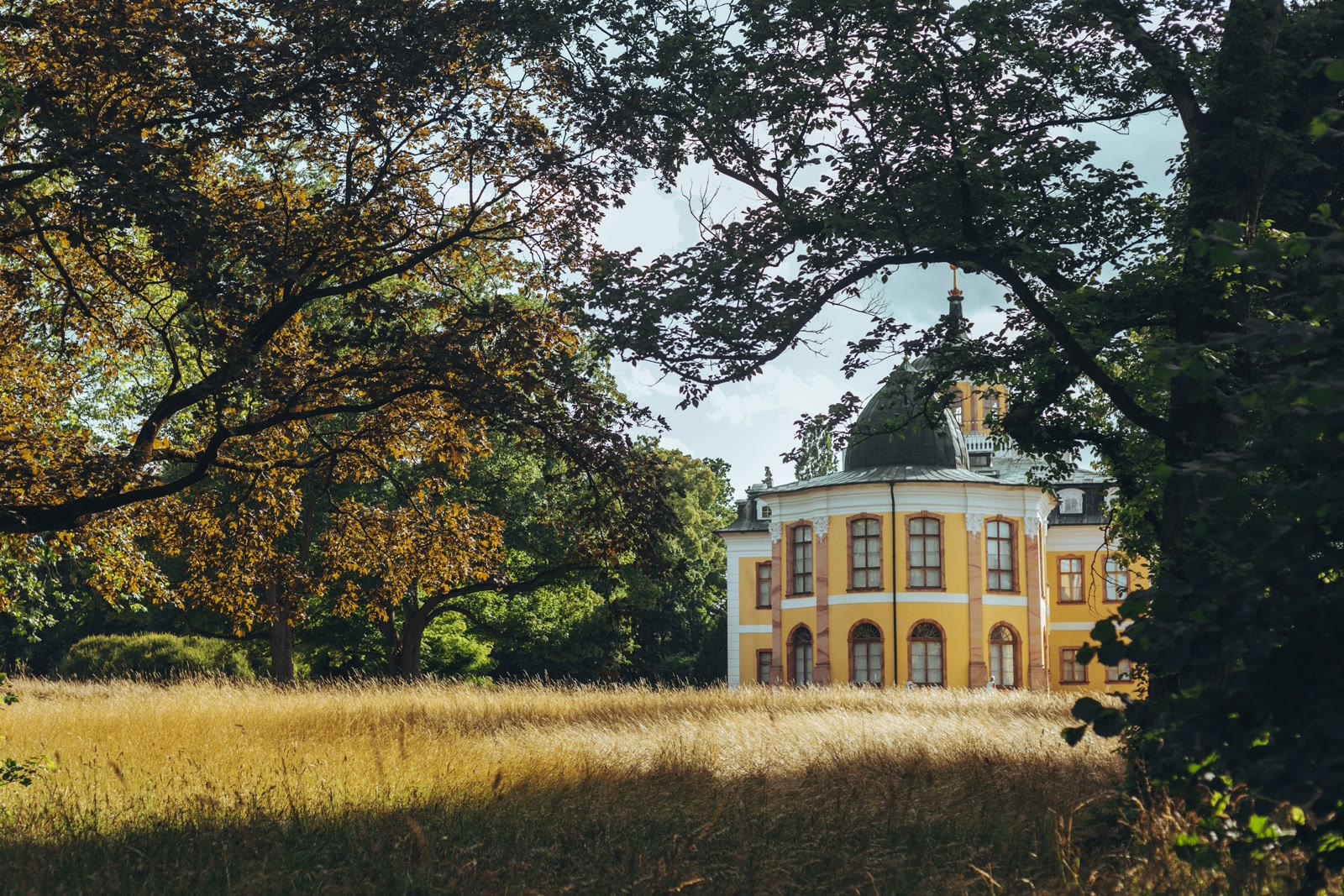
Walk the compact old town and you can trace 250 years of German cultural history in under a kilometre. The Goethe House on Frauenplan, the Schiller House on Schillerstrasse and the Anna Amalia Library all sit within a few minutes of each other, while the Bauhaus Museum marks the city’s other great contribution, the modern design school that reshaped 20th-century architecture. The Ilm river runs through Park an der Ilm, a landscape park Goethe himself helped shape. For a city of its size, Weimar rewards a longer stay: the Buchenwald Memorial, Belvedere Castle and the surrounding Thuringian countryside add a second and third day.
Weimar Weather at a Glance
Weimar has a continental climate with four distinct seasons. Summers are warm, with July and August both averaging highs of 23°C (73°F) and lows of 12-13°C (54-55°F), but these are also the wettest months, with 60-75 mm of rain each. Winters are cold but not severe: January averages a high of 2°C (36°F) and a low of -3°C (27°F), with light snow on 15-20 days across the season.
Annual rainfall totals about 580 mm, which is low for Germany, because the Thuringian Basin sits in a rain shadow. Sunshine averages about 1,550 hours a year, peaking at around 210 hours in May and July. Spring and autumn are changeable, with the foggiest conditions in October and November. The full month-by-month breakdown, including a comparison table, is in the Weimar weather by month guide.
Seasonal Snapshot
- Spring (March to May): Temperatures climb from 8°C to 18°C, rain picks up to 55 mm in May, and the parks and Belvedere gardens come into bloom. The Thuringia Bach Weeks run around Easter.
- Summer (June to August): The warmest season at 21-23°C, but the wettest, with July’s 75 mm spread over about 15 wet days. The Kunstfest and Yiddish Summer fill the calendar.
- Autumn (September to November): September is mild and drier at 18°C; October brings the Onion Market and peak foliage, and November turns cold and foggy.
- Winter (December to February): Highs of 2-4°C, light snow and short days, but the Christmas market runs to 23 December and hotel prices are at their lowest.
Weimar Travel Guides
- Weimar Weather by Month – temperatures, rainfall and sunshine for every month, with a comparison table.
- Best Time to Visit Weimar – the best months for weather, festivals and lower prices, and when to avoid.
- Things to Do in Weimar – museums, monuments and parks with opening hours and ticket prices.
- Weimar Events and Festivals – the Onion Market, Kunstfest, Bach Weeks and the Christmas market.
- Weimar Neighborhoods – where each district sits, who it suits and what hotels cost.
- Where to Stay in Weimar – hotel recommendations for the old town and Goethepark areas.
- Weimar Travel Tips and FAQ – airports, transport fares, tipping and safety.
Location and Climate Context
Weimar lies in the centre of Germany, in Thuringia, about 20 km east of Erfurt and 230 km southwest of Berlin. Its inland position, away from the moderating Atlantic, produces the wider temperature swings of a continental climate, while the Thuringian Basin’s low elevation and rain shadow keep annual rainfall under 600 mm. The Ettersberg hill rises to the north, where the Buchenwald Memorial stands, and the Ilm river cuts a green valley through the city. This geography shapes both the weather and the city’s layout, with the old town on the river’s west bank.
Quick Facts
- Warmest month: July, average high 23°C (73°F)
- Coldest month: January, average low -3°C (27°F)
- Wettest month: July, about 75 mm
- Driest month: February, about 35 mm
- Annual rainfall: about 580 mm
- Annual sunshine: about 1,550 hours
- Elevation: 265 m above sea level
- Nearest airport: Erfurt-Weimar (ERF), 45 km
Where to Stay in Weimar
Most visitors stay in or beside the old town, where the sights are, or in the greener Goethepark area a five-minute walk west. The station area to the south holds the budget options. Prices run roughly 100-200 EUR per night in the Altstadt, 90-150 EUR around Goethepark, and from about 50 EUR near the station, with rates spiking in August and October. The where to stay in Weimar guide breaks down every area in detail.
Suggested Hotels in Weimar
Hotel Elephant Weimar
This five-star Autograph Collection hotel on the Marktplatz has hosted Goethe, Thomas Mann and world leaders across 300 years, with a Michelin-listed restaurant and a spa. Best for couples and history buffs who want the city’s most storied address. Check rates and availability
Leonardo Hotel Weimar
A four-star hotel beside Park an der Ilm with spacious air-conditioned rooms, an indoor pool and free Wi-Fi. Best for families who want a pool and green surroundings a short walk from the centre. Check rates and availability
a&o Weimar
A modern budget hotel and hostel 1.5 km from the centre and a ten-minute walk from the station, with a garden, games room and free Wi-Fi. Best for solo travellers and groups who want the lowest prices. Check rates and availability
