

 Patchy rain nearby
 This post may contain affiliate links. If you purchase through them, I may earn a small commission at no extra cost to you. Thanks for supporting our small business.
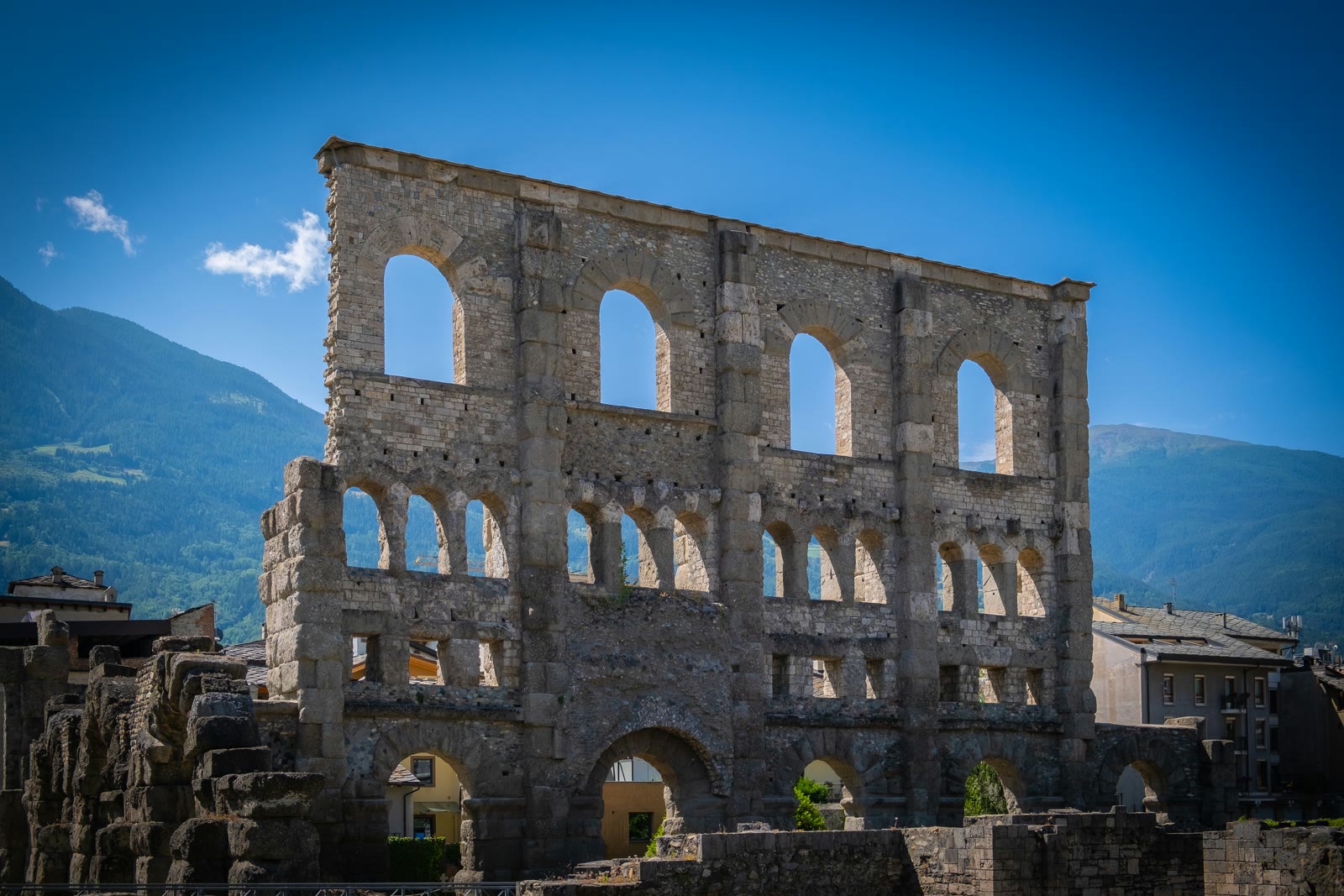
Aosta is the capital of Italy’s smallest and least-populated region, the Aosta Valley (Valle d’Aosta), tucked between Mont Blanc and the Matterhorn in the western Alps. The city was founded as Augusta Praetoria by the Romans in 25 BC, and its compact historic centre preserves more standing Roman monuments than any city north of Rome: walls, gates, a theatre, a forum, and the Arch of Augustus, all within a 15-minute walk. At 583 metres elevation and ringed by peaks above 4,000 metres, Aosta has genuine Alpine weather: snowy winters supporting the Pila ski resort (reachable by city-centre cable car in 15 minutes), mild summers ideal for hiking in Gran Paradiso National Park, and spectacular autumn foliage in the larch forests. The city is bilingual Italian-French and serves as a natural base for exploring the valley’s castles, thermal springs at Pré-Saint-Didier, and the Skyway Monte Bianco cable car to 3,466 metres. For a complete month-by-month breakdown, see our Aosta weather by month guide.
Aosta Climate at a Glance
Aosta has a continental Alpine climate with four distinct seasons. Winters (December-February) are cold and relatively dry, with daytime highs of 4-7°C (39-45°F) and nights dropping to -4°C to -2°C (25-28°F). Most precipitation falls as snow at city level, and the Pila ski area above the city holds reliable snow from mid-December through late March. Summers (June-August) are warm with July highs averaging 27°C (81°F) and nights around 14°C (57°F). Afternoon thunderstorms are frequent (8-11 days per month) but pass quickly. Annual precipitation totals about 910 mm (36 inches), with May the wettest month (110 mm) and January the driest (55 mm). Spring and autumn are transitional: April and October offer mild days (15°C / 59°F) at lower prices, while November is the least appealing month with grey skies, rain/snow mix, and many hotels closed. For help choosing when to come, read our best time to visit Aosta guide.
Aosta Seasonal Snapshot
- Winter (December-February): Ski season at Pila, Sant’Orso Millennial Fair (January 30-31), Christmas market in Piazza Chanoux. Cold but the driest season. The city is festive and uncrowded outside the fair dates. Best for skiers and winter culture.
- Spring (March-May): Rapid snowmelt, wildflowers in the valley floor by April, hiking season begins on lower trails. Rain peaks in May (13 rain days) but temperatures reach a pleasant 20°C (68°F). Hotel prices are 30-40% lower than summer. Best for budget travellers and spring hikers.
- Summer (June-August): Peak tourist season with 8-9 hours of daily sun, highs of 24-27°C (75-81°F). All cable cars, refuges, and mountain passes are open. Book hotels 2+ months ahead for July and August. Best for hiking, climbing, cycling, and the Celtica Festival (early July).
- Autumn (September-November): September is arguably the best all-round month: warm (21°C / 70°F), fewer crowds after Italian holidays end, and clear skies. October brings golden larch foliage and the Marché au Fort food festival. November is cold, grey, and many facilities close. Best for culture and food in September-October; avoid November.
Explore Aosta: Complete Travel Guides
- Aosta Weather by Month: Detailed monthly breakdown with temperature and rainfall tables, snowfall patterns, sunshine hours, and what to pack for each season. Essential for planning around Aosta’s Alpine climate.
- Best Time to Visit Aosta: When to come for skiing, hiking, festivals, lowest prices, and fewest crowds. Includes the one month to avoid and why.
- Things to Do in Aosta: Roman ruins (Arch of Augustus, theatre, Porta Praetoria), medieval churches, the Pila ski resort, Gran Paradiso hikes, Courmayeur and Skyway Monte Bianco, and the Aosta Valley castles (Fénis and Issogne).
- Aosta Events and Festivals: The 1,000-year-old Sant’Orso craft fair, Aosta Valley Carnival with wooden masks, Bataille de Reines cow tournaments, Celtica music festival, Marché au Fort food fair, and Christmas market.
- Best Neighborhoods in Aosta: Historic centre (Roman walls), Pila cable car zone, southern residential area, and eastern suburbs for drivers. Hotel price ranges and who each area suits.
- Where to Stay in Aosta: Specific hotel recommendations at luxury, mid-range, and budget tiers for each neighbourhood. Includes Booking.com links with real availability.
- Aosta Travel Tips and FAQ: Airport connections (Turin, Milan, Geneva), train from Turin, getting around, tipping, safety, local food (fontina, mocetta, tegole), and answers to common visitor questions.
Quick Facts About Aosta
- Population: ~34,000 (the smallest regional capital in Italy)
- Elevation: 583 metres (1,913 feet)
- Languages: Italian and French (official), Franco-Provencal patois (regional)
- Founded: 25 BC as Augusta Praetoria by Emperor Augustus
- Best ski months: January to early March (most reliable snow)
- Warmest month: July (27°C / 81°F average high)
- Coldest month: January (4°C / 39°F average high, -4°C / 25°F low)
- Wettest month: May (110 mm, 13 rain days)
- Sunniest months: July (9 hours/day), June and August (8 hours/day)
- Nearest airport: Turin-Caselle TRN (110 km, 1h45 by bus)
- Signature food: Fontina DOP cheese, mocetta (dried beef), polenta concia, tegole cookies
- Signature drink: Blanc de Morgex et de La Salle (Europe’s highest-altitude white wine), génépy liqueur
Suggested Hotels in Aosta
Hostellerie du Cheval Blanc (Luxury)
Four-star hotel in the heart of Aosta Valley, 800 metres from the Pila cable car. Features a Valdostan restaurant, free parking, and garden with mountain views. Best for skiers and couples who want a full-service Alpine hotel. Check rates and availability
Duca D’Aosta Hotel (Mid-Range)
Four-star hotel in a renovated historic brick building between the train station and Roman Theatre. Retro-style rooms with French oak floors, minibar, and LED TV. Best for travellers wanting historic character at a reasonable price. Check rates and availability
OMAMA Hotel (Budget)
Clean, modern budget hotel 10 minutes from the Pila cable car and 15 minutes to the historic centre. Air-conditioned rooms with private bathrooms, flat-screen TVs, and a shared lounge. Best for budget travellers and skiers wanting functional comfort. Check rates and availability
