

 Light rain shower
 Overcast
 Sunny
 Partly Cloudy
This post may contain affiliate links. If you purchase through them, I may earn a small commission at no extra cost to you. Thanks for supporting our small business.
Freiburg im Breisgau sits at the southwestern edge of Germany’s Black Forest where the Dreisam River meets the Rhine Valley plain, right in the warmest corner of the country. With 1,800 hours of annual sunshine, average July highs of 25.5°C (78°F), and a medieval Altstadt rebuilt after wartime destruction to its original layout, Freiburg combines the outdoor access of the Black Forest with genuine urban culture. It’s a university city (founded 1457), Germany’s eco-capital, and the gateway to Baden’s wine country , all within 15 km of the French border and 70 km from Switzerland. The city’s 230,000 residents share streets with the famous Bächle canals, open-air markets that have run since the 15th century, and an unusually sunny climate that earned it the nickname “Germany’s Tuscany.”
Welcome to Freiburg: Germany’s Sunniest City
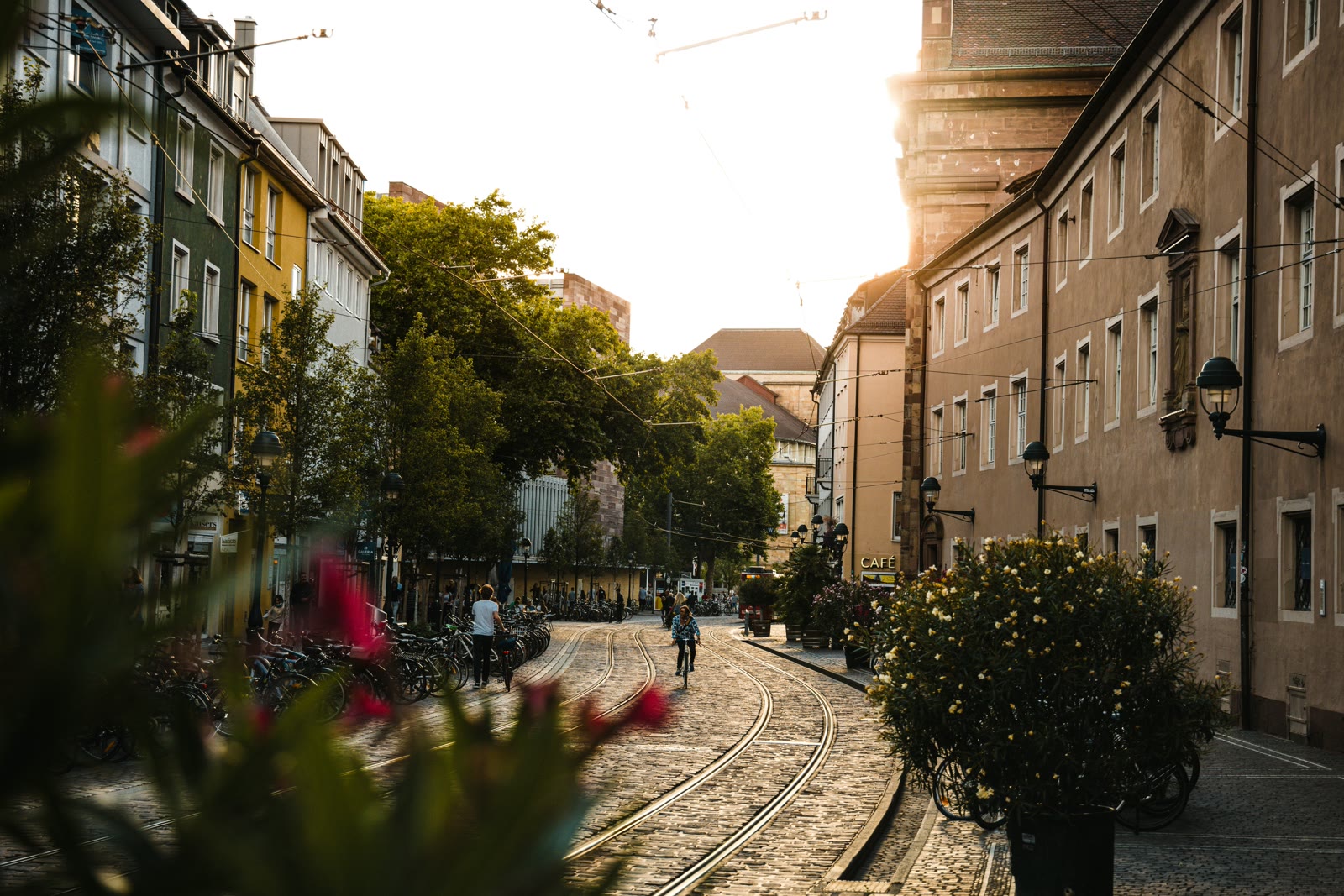
Freiburg’s climate sets it apart from every other German city. Sheltered by the Vosges Mountains to the west and the Black Forest to the east, the Upper Rhine rift valley traps warm air and blocks Atlantic weather fronts that drench the rest of Germany. The result: summers that regularly reach 30°C (86°F), winters that rarely dip below -2°C (28°F), and an annual rainfall of 830 mm concentrated in summer thunderstorms rather than the grey drizzle northern Germany endures. The city leans into its climate with an outdoor culture built around café terraces on Münsterplatz, cycling paths along the Dreisam River (Freiburg has twice as many bicycles as cars per capita), and the Bächle , small open water channels running through the streets of the Altstadt that provide natural air conditioning on hot days.
The Black Forest rises immediately east of the city. From the Schlossberg (120 m above the Altstadt, a 20-minute walk) you get a full panorama of the Münster spire against the dark forested hills. The Schauinsland mountain (1,284 m, reached by Germany’s longest loop cable car) has skiing in winter and hiking with Alpine views on clear days. The Kaiserstuhl volcanic hills to the west produce Spätburgunder (Pinot Noir) that rivals Burgundy. About 25% of Freiburg’s visitors use it purely as a Black Forest base; the other 75% discover a city that holds its own as a destination.
Freiburg Seasonal Snapshot
- Spring (March-May): The season arrives 2-3 weeks earlier than in northern Germany. By mid-March, café terraces open and the Münstermarkt fills with white asparagus (Spargel) from late April. May brings 20°C (68°F) highs, 205 sun hours, and some of the year’s best hiking conditions before summer thunderstorms begin.
- Summer (June-August): Peak season with 25.5°C (78°F) July highs, 238 sun hours, and 15-20 days above 30°C (86°F). The Weinfest (late June/early July) and Zelt-Musik-Festival (July) draw the biggest crowds. Hotel prices rise 30-40% above annual average , book 2-3 months ahead.
- Autumn (September-November): September is arguably the best month: 20.4°C (69°F), 167 sun hours, wine harvest season in the Kaiserstuhl, and noticeably fewer tourists than July-August. October brings peak foliage around the third week. November is grey and quiet until the Christmas Market opens around the 21st.
- Winter (December-February): Mild by German standards , January highs of 4.7°C (40°F) with snow rare in the city center. The Christmas Market (late November to December 23) is the winter highlight. January and February are the low season for tourism, with hotel rates 30-50% below summer peaks. Skiers use Freiburg as a base for Feldberg (1,493 m, 35 km away).
Explore Freiburg: Complete Travel Guides
- Freiburg Weather by Month: Monthly temperatures, rainfall, sunshine hours, and seasonal packing lists with data from the German Weather Service (DWD).
- Best Time to Visit Freiburg: Season-by-season analysis of weather, crowds, hotel prices, wine festivals, Christmas Market dates, and Black Forest hiking conditions.
- Things to Do in Freiburg: The 116-metre Münster tower, Bächle canals, Schlossberg views, Augustiner Museum, Schauinsland cable car, and Kaiserstuhl wine tasting with opening hours, ticket prices, and transport details.
- Freiburg Events and Festivals: Annual events calendar covering the Weinfest (June), Zelt-Musik-Festival (July), Oberlindenhock (September), Christmas Market (November-December), and Fasnet Carnival (February).
- Best Neighborhoods in Freiburg: Altstadt, student-friendly Stühlinger, upscale Wiehre, eco-utopian Vauban, and hillside Herdern with hotel price ranges and transport links for each.
- Where to Stay in Freiburg: Detailed hotel recommendations by area: luxury Colombi Hotel and mid-range Hotel Rappen in the Altstadt, Mercure and IntercityHotel near the station, boutique options in Wiehre, and budget hostels in Stühlinger.
- Freiburg Travel Tips and FAQ: Basel and Frankfurt airport transfers (with costs), VAG tram tickets and bike rental, visa requirements, tipping customs in euros, safety data, and where to find the best Lange Rote sausage at the Münstermarkt.
Where is Freiburg and What Makes Its Weather Special?
Freiburg sits at 48°0’N, 7°51’E at the western foot of the Black Forest in the state of Baden-Württemberg, 15 km east of the Rhine River (which forms the French border here) and 70 km north of Basel, Switzerland. The city’s elevation is 278 m at the Münster, but the surrounding geography shapes its climate dramatically. The Upper Rhine Graben , a rift valley flanked by the Vosges Mountains (France, west) and the Black Forest (Germany, east) , funnels warm Mediterranean air northward while the Vosges block Atlantic moisture. This creates a rain shadow effect that gives Freiburg roughly 300 more sunshine hours annually than Berlin and 500 more than Hamburg. The Kaiserstuhl hills immediately west of Freiburg are volcanic in origin, and their dark basalt soils absorb heat, making them Germany’s warmest agricultural area and the source of the region’s celebrated Spätburgunder red wines.
Freiburg Quick Facts
- Best months to visit: May, June, September (warm, sunny, fewer crowds than July-August)
- Warmest month: July (25.5°C / 78°F average high)
- Coolest month: January (4.7°C / 40°F average high, -0.8°C / 31°F average low)
- Sunniest month: July (238 hours)
- Wettest month: May (92 mm, mainly from afternoon thunderstorms)
- Annual sunshine: About 1,800 hours (highest in Germany)
- Annual rainfall: About 830 mm across 130 rain days
- Nearest airport: EuroAirport Basel-Mulhouse-Freiburg (BSL/MLH/EAP), 70 km south
- Train connections: ICE high-speed trains to Frankfurt (2 hours), Basel (30 minutes), Zurich (2 hours), Paris (3.5 hours via Strasbourg)
- Population: 230,000 (city), 650,000 (metropolitan area)
Suggested Hotels in Freiburg
Colombi Hotel
Freiburg’s only 5-star hotel occupies a prime location opposite Colombi Park, a 5-minute walk from the Münster. The family-run property features an indoor pool, a Michelin-starred restaurant (Zirbelstube), and spacious air-conditioned rooms , a rarity in Freiburg. Best for luxury travelers and special occasions. Check rates and availability
Hotel Rappen am Münsterplatz
Family-run 3-star hotel directly on Münsterplatz with cathedral-view rooms. Simple but comfortable, with cable TV and private bathrooms. The location is unbeatable for the Christmas Market and Weinfest. Best for travelers who want to be steps from everything. Check rates and availability
Black Forest Hostel
Well-rated hostel an 8-minute walk from the Münster with dorm beds from 25 euros and private doubles from 65 euros. Shared kitchen, free WiFi, and a social but not party-heavy atmosphere. Best for solo travelers and backpackers. Check rates and availability
