

 Partly Cloudy
 Overcast
 Sunny
 Patchy rain nearby
This post may contain affiliate links. If you purchase through them, I may earn a small commission at no extra cost to you. Thanks for supporting our small business.
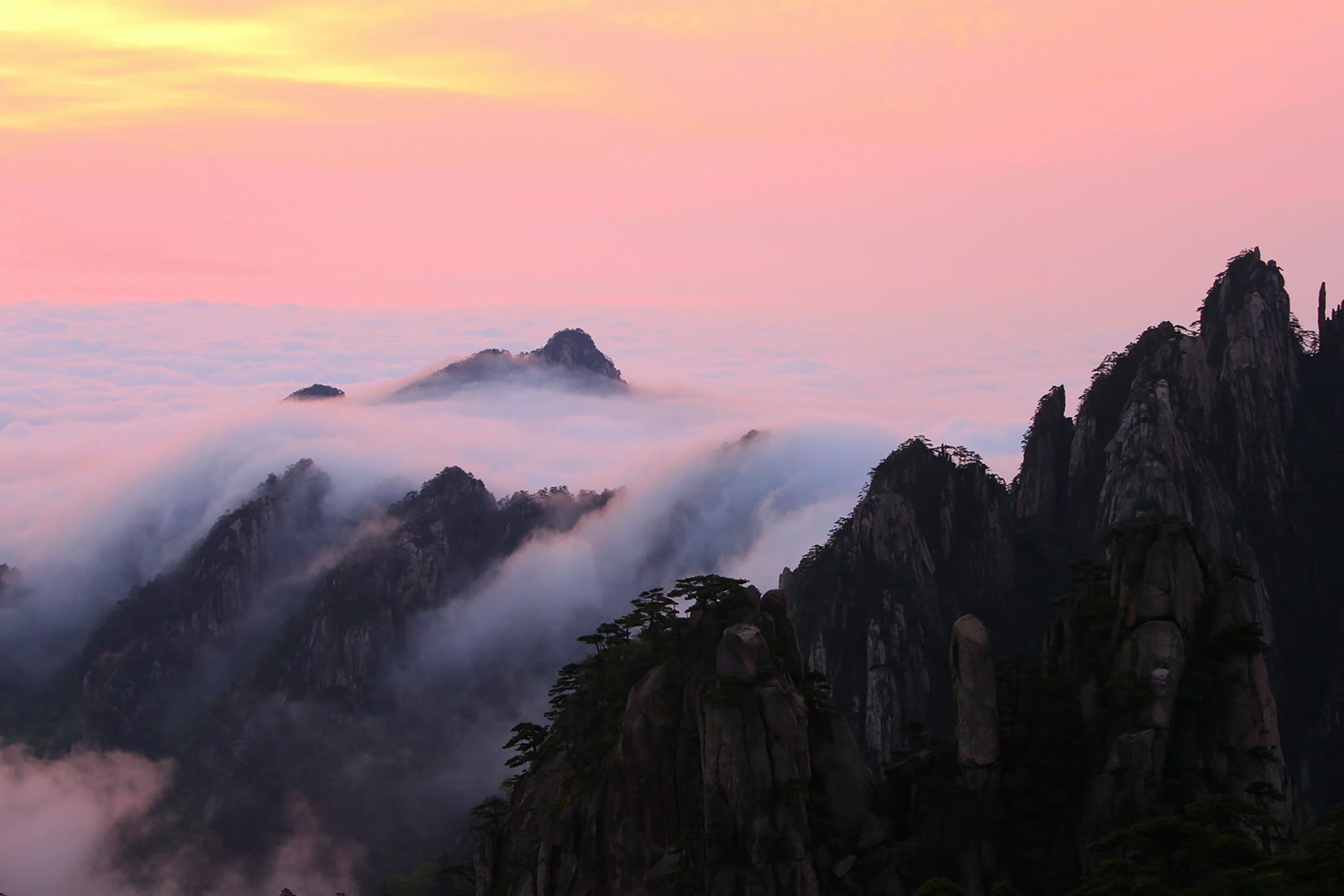
Huangshan, the Yellow Mountain of southern Anhui, draws visitors for one thing above all: granite peaks, wind-sculpted pines and a sea of clouds that fills the valleys at dawn. The scenic area holds 72 named peaks across 154 square kilometres, topped by Lotus Peak at 1,864 metres, and the ancient villages of Hongcun and Xidi sit an hour away as UNESCO World Heritage sites in their own right. The city of Huangshan (Tunxi) averages 16.4C (61.5F) across the year, but the summit runs a full 6 to 8C colder, so a base-town forecast is not the one you pack for. Start with the Huangshan weather by month guide, then work through the cluster below.
Welcome to Huangshan
The practical core of a Huangshan trip is a two-day loop: one day on the mountain, ideally with an overnight at 1,600 metres for sunrise, and a second day for Hongcun and Tunxi Old Street. Tickets, cable cars and summit beds are the three things that sell out in peak season, so lock those in first. From Huangshan North high-speed rail station, Shanghai is 2.5 to 3 hours away, Hefei about 1.5 hours, which makes the mountain a realistic weekend trip from the Yangtze Delta. Use the Huangshan travel tips guide to sort transport before you arrive.
Huangshan Weather at a Glance
Huangshan has a humid subtropical climate with a sharp mountain-versus-city split. The city of Tunxi sees January lows around 1C (34F) and July highs of 32C (90F), with 1,670mm of rain a year concentrated from May to July. The summit averages just 7.8C (46F) year-round, stays below 0C (32F) through much of winter, and sits in fog or cloud on many days from June to August. The sea of clouds appears most often after rain in autumn and early winter, which is why October and November are the peak photography months. See the best time to visit Huangshan guide for the exact windows.
Seasonal Snapshot
- Spring (March to May): Azaleas bloom in late April and May, temperatures climb to 21 to 25C (70 to 77F) in the city, but rain runs 140 to 220mm a month.
- Summer (June to August): Hot and humid, 28 to 32C (82 to 90F) in the city, plum rain in June and early July, fog can hide the views for days.
- Autumn (September to November): The best season: drier air, the sea of clouds, autumn foliage from mid-October, summit temperatures 5 to 15C (41 to 59F).
- Winter (December to February): Cold with snow and rime ice, summit temperatures near or below freezing, empty trails and 150 CNY off-season entry.
Explore Huangshan
- Huangshan Weather by Month: temperatures, rainfall and the sea of clouds month by month, with a full comparison table. Read the guide
- Best Time to Visit Huangshan: the exact date windows for clear skies, fewest crowds and lowest prices, and which months to skip. Read the guide
- Things to Do in Huangshan: Lotus Peak, Bright Summit, the Xihai Grand Canyon, Hongcun and Tunxi Old Street, with prices and hours. Read the guide
- Huangshan Festivals and Events: the azalea bloom, tea-picking season, photography festival and the national holidays to plan around. Read the guide
- Huangshan Neighborhoods: Tunxi, Tangkou and the summit areas, with what each base suits and average hotel prices. Read the guide
- Where to Stay in Huangshan: hotel picks on the mountain, in Tangkou and in Tunxi for every budget, with Booking.com links. Read the guide
- Huangshan Travel Tips and FAQ: airport and rail connections, tickets, visas, money, safety and connectivity, plus quick answers. Read the guide
Location and Geography
Huangshan sits in the far south of Anhui province, about 500km southwest of Shanghai and 320km west of Hangzhou, on the edge of the Yangtze River delta. The mountain range is a block of granite uplifted and carved over millions of years into vertical spires and deep gorges, with three main gateways: the South Gate at Tangkou, the North Gate at Taiping, and the East Gate at Yungu. Tangkou is the gateway most visitors use because it has the densest hotels and the most frequent shuttles. The city of Tunxi, 70km to the south, holds the airport and the main transport hub, while Hongcun and Xidi sit west near Yixian county. The full set of sights is in the things to do in Huangshan guide.
Quick Facts
- Highest peak: Lotus Peak, 1,864 metres (6,115 ft).
- City annual temperature: 16.4C (61.5F); summit annual temperature 7.8C (46F).
- Annual rainfall: about 1,670mm, concentrated in May to July.
- Park entry: 190 CNY peak season, 150 CNY off-season.
- Best months: late April to early May, and late September to mid-November.
- Sea of clouds season: October and November, early mornings after rain.
- Nearest airport: Huangshan Tunxi International Airport (TXN), 7km from the city.
- Nearest high-speed rail: Huangshan North Station, 2.5 to 3 hours from Shanghai.
Where to Stay in Huangshan
Stay on the mountain in the Beihai or Xihai areas if you want sunrise without a 04:00 start, in Tangkou at the South Gate for the best value and the first shuttle, or in Tunxi for city comfort, food and transport. Summit rooms run 800 to 2,000 CNY a night, Tangkou 150 to 600 CNY, and Tunxi 200 to 800 CNY. The where to stay in Huangshan guide lists named hotels in each area.
Suggested Hotels in Huangshan
Crowne Plaza Huangshan Yucheng
An IHG five-star in the Tunxi district with an indoor pool, fitness centre and spacious air-conditioned rooms, close to the Xin’an River. Best for couples and business travelers who want the most polished stay in the city. Check rates and availability
Xihai Hotel
A five-star summit hotel on the west side of the mountain, close to the Xihai Grand Canyon loop and with panoramic decks for sunset over the peaks. Best for couples and photographers who want the most comfortable base at altitude for sunrise. Check rates and availability
Hui Boutique Hotel
A boutique hotel with rustic wood walls, antique sculptures and Chinese calligraphy, two minutes from Daizhen Park and ten minutes from the railway station. Best for budget travelers who still want character and a local feel. Check rates and availability
