

 Overcast
 Sunny
 Fog
 Patchy rain nearby
This post may contain affiliate links. If you purchase through them, I may earn a small commission at no extra cost to you. Thanks for supporting our small business.
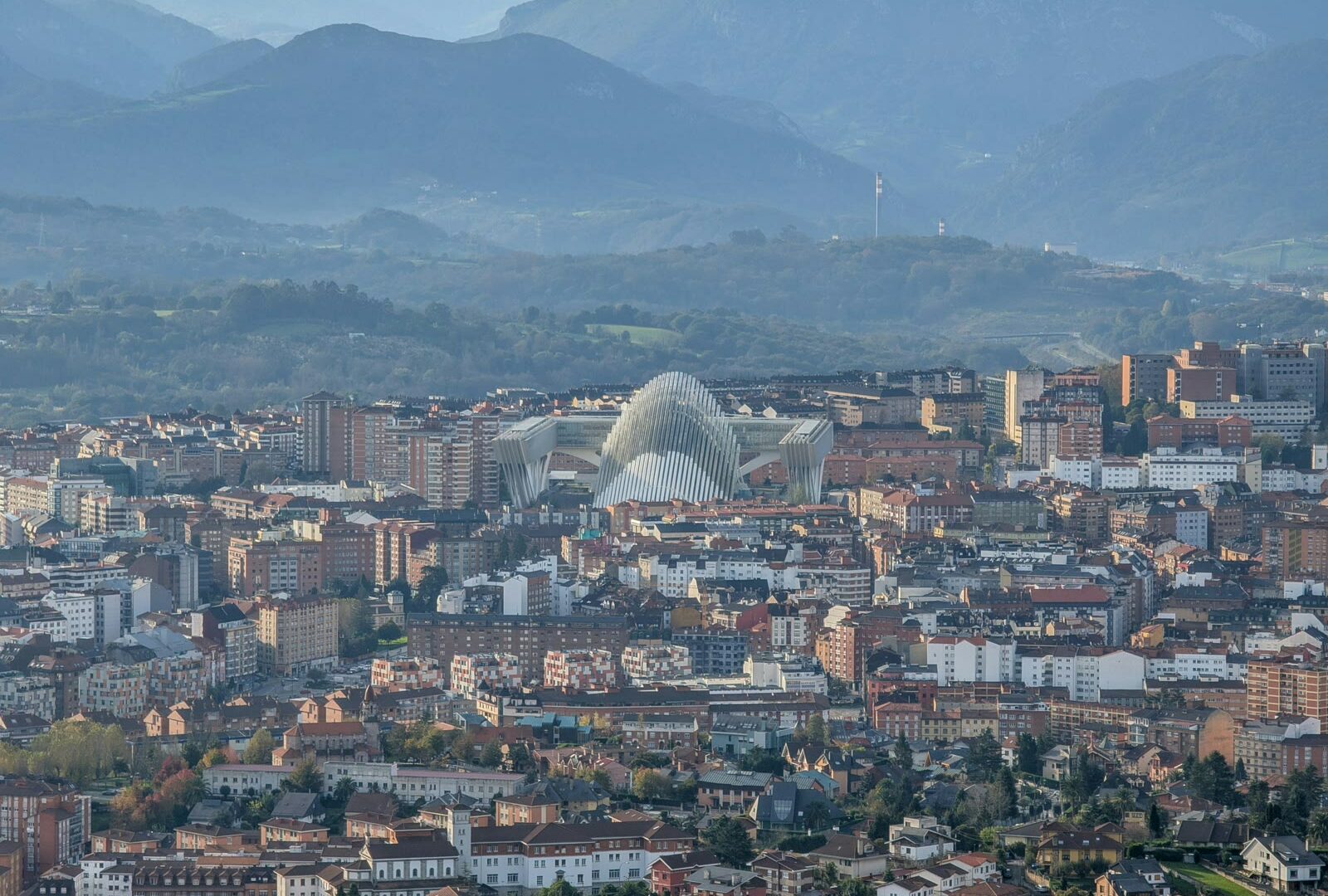
Oviedo is the capital of Asturias in northern Spain, a compact city of around 220,000 people that sits 232 metres above sea level at the foot of the Naranco hill, about 26 km inland from the Bay of Biscay. Its Atlantic climate brings mild summers, cool winters, and rain spread across twelve months, earning Asturias the name Green Spain. The city is the starting point of the Camino Primitivo, the oldest pilgrimage route to Santiago, and home to three UNESCO-listed pre-Romanesque monuments plus one of the country’s richest public sculpture collections. Expect July highs around 22°C (72°F), over 1,000 mm of annual rain, and a food culture built on cider, fabada bean stew, and Cabrales cheese.
Welcome to Oviedo
You’ll notice Oviedo’s rhythm on your first evening: the sound of cider being poured from arm’s height (the escanciado) spilling from the chigres on Calle Gascona, the steady clop of cobbled streets in the old town, and locals strolling the Campo de San Francisco as evening cools the city. There’s no beach and no rush-hour crush; instead there are stone lanes, early-medieval churches that predate most of Europe’s great cathedrals, and a botanist’s wetness that keeps everything green even in August. It’s a city to walk slowly, usually with an umbrella folded in your bag.
Oviedo Weather at a Glance
Oviedo has a true oceanic climate (Köppen Cfb): no month averages below freezing and none reaches 24°C (75°F), which is rare for Spain. January is the coldest month at 8.4°C (47°F); August is the warmest at 19.3°C (67°F). Rain totals about 1,005 mm (39.6 in) a year, peaking in November at 120 mm and easing to a July low of 38 mm. Sunshine averages around 1,700 hours annually, with only 3 hours a day in midwinter but 6 hours in July. The Bay of Biscay warms to about 20°C (68°F) at its August peak, and sea fog can drift up the Nalón valley on winter mornings. For the full table, open the Oviedo weather by month guide.
Seasonal Snapshot
- Winter (Dec-Feb): 12-13°C (54-55°F) highs, 4-5°C (39-41°F) lows, wettest and darkest months with 3 hours of sun; snow is rare in the city itself.
- Spring (Mar-May): warming to 19°C (66°F) by May, April is the rainy peak at 92 mm, parks bloom and cider terraces reopen.
- Summer (Jun-Aug): mild and driest, 21-23°C (70-73°F) highs, 38-45 mm rain, one of Spain’s coolest capital cities.
- Autumn (Sep-Nov): September holds 22°C (72°F) and the big festivals; November is the rainiest month at 120 mm.
Quick Facts
- Warmest months: July and August, averaging 22-23°C (72-73°F) by day
- Coolest month: January at 8.4°C (47°F)
- Wettest month: November, about 120 mm
- Driest month: July, about 38 mm
- Annual sunshine: roughly 1,700 hours
- Nearest airport: Asturias Airport (OVD), 45 km northwest
All Oviedo Guides
- Oviedo Weather by Month – monthly temperatures, rainfall, and sunshine with a comparison table.
- Best Time to Visit Oviedo – the exact months for good weather, low prices, and fewest crowds.
- Things to Do in Oviedo – monuments, museums, and cider bars with hours and prices.
- Events and Festivals in Oviedo – Holy Week, the Ascension fair, and San Mateo.
- Best Neighborhoods in Oviedo – the old town, Uría, Naranco, and the student quarter.
- Where to Stay in Oviedo – hotels by area and budget tier.
- Oviedo Travel Tips and FAQ – airports, transport costs, tipping, and safety.
Where Oviedo Sits and Why It Rains
Oviedo lies in a broad valley opened by the Nalón river, walled to the north and west by the Aramo and Naranco ranges and open to moist Atlantic air from the Bay of Biscay just 26 km away. That geography is the whole weather story: westerly winds push humid fronts over the Cantabrian mountains, where the rising air releases rain over Oviedo and the Asturian interior, keeping the province lush while most of Spain bakes. The Picos de Europa, 90 minutes south, catch heavy snow in winter and feed the region’s rivers through spring. Oviedo itself rarely freezes because the mild ocean air buffers the valley.
When to Visit Oviedo
Come in June, early July, or September for the best trade of warm, dry days against moderate crowds, and time a September trip to catch San Mateo week and the Día de América en Asturias on the third Sunday. Avoid November and December if constant rain and 3-hour days will blunt an outdoor trip, and skip the second half of August if you’d rather not pay peak rates during the Assumption fiesta. There is no month here that’s too hot or too cold to walk the city, which is its year-round advantage. The full logic is in the best time to visit guide.
Where to Stay in Oviedo
Base yourself in the Casco Antiguo for atmosphere and doorstep access to the monuments and cider bars, on Calle Uría for rail connections and big-name hotels, or up on the Naranco slopes for quiet and lower prices. Mid-range doubles run about €60 to €90 a night outside festival weeks. For full area breakdowns and specific properties, see the where to stay guide.
Suggested Hotels in Oviedo
Eurostars Hotel de la Reconquista
A five-star landmark set in an 18th-century national monument beside the Campo de San Francisco, with a grand courtyard and one of the city’s finest restaurants. Best for couples and special occasions. Check rates and availability
Barceló Oviedo Cervantes
A polished four-star minutes from the old town, pairing spacious designer rooms with a restaurant known for Asturian-meets-modern cooking. Best for first-time visitors. Check rates and availability
Sercotel Ciudad de Oviedo
A dependable classic mid-range hotel a short walk from the historic centre, with solid rooms and breakfast at fair prices. Best for value-focused travellers. Check rates and availability
