

 Light drizzle
 Patchy rain nearby
 Light rain
 Overcast
 Partly Cloudy
This post may contain affiliate links. If you purchase through them, I may earn a small commission at no extra cost to you. Thanks for supporting our small business.
Trier, founded as Augusta Treverorum in 16 BC, is Germany’s oldest city and sits in the Moselle River valley in the state of Rhineland-Palatinate. The city’s UNESCO-listed Roman monuments, including the Porta Nigra, Imperial Baths, and amphitheater, draw 3.5 million visitors annually. Trier’s oceanic climate (Köppen Cfb) delivers mild winters and warm summers, with January averaging 1.5°C (35°F) and July reaching 18.6°C (65°F). Annual rainfall of 774mm (30.5 inches) is spread across roughly 160 days, making a rain jacket useful year-round. The surrounding Eifel and Hunsrück mountains funnel weather patterns through the valley, while the steep slate vineyards above the Moselle produce some of Germany’s finest Rieslings. At just 110,000 residents, Trier is compact enough to explore on foot but dense enough with Roman history, Gothic cathedrals, and wine taverns to fill several days.
Welcome to Trier
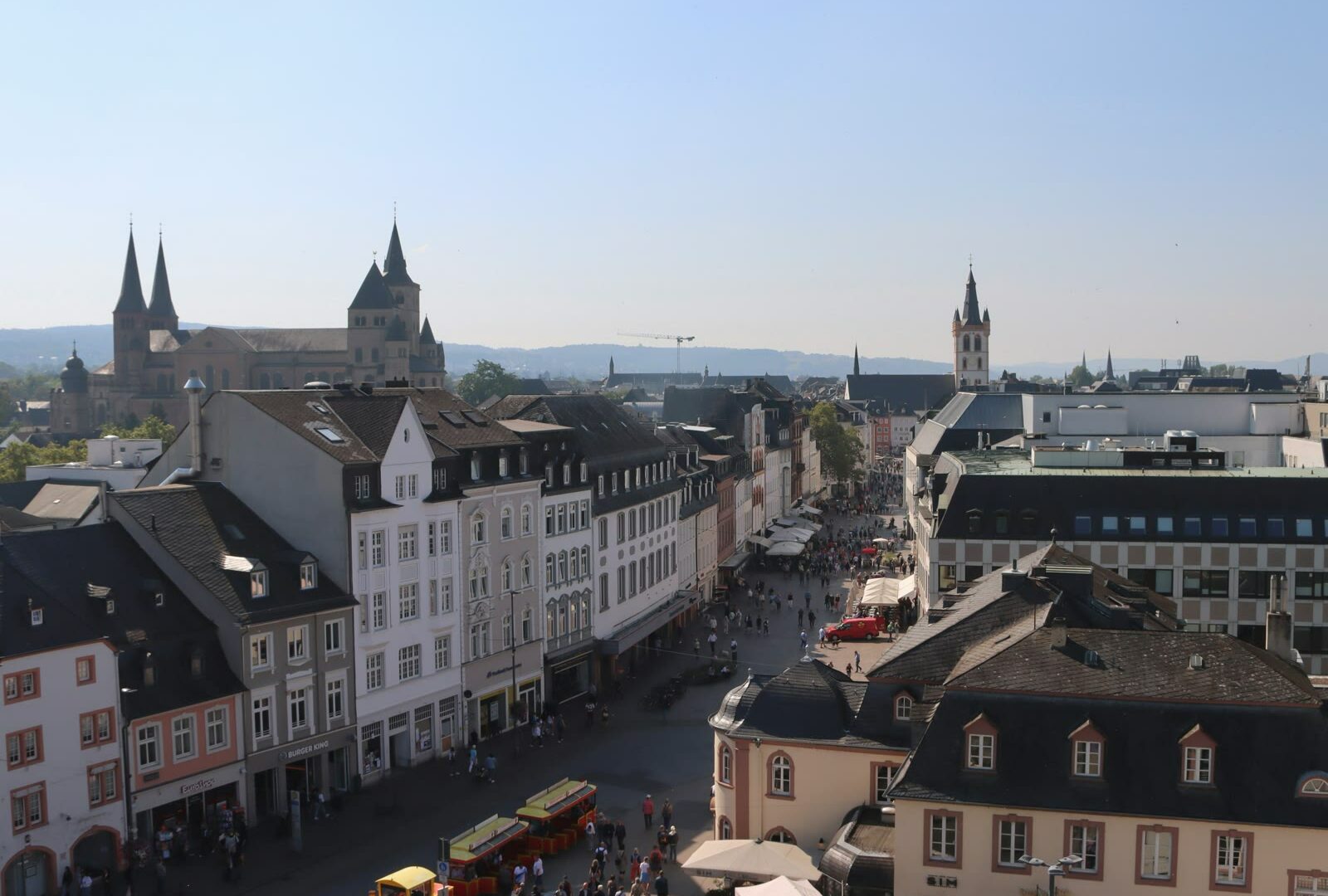
Standing in front of the Porta Nigra, the 2nd-century Roman gate that has darkened to near-black over two millennia of weathering, you understand why Trier calls itself the oldest city in Germany. The gate’s sandstone blocks, held together without mortar by iron clamps, have watched over this Moselle valley settlement since the reign of Marcus Aurelius. Trier was once an imperial capital, home to Constantine the Great before he moved east to found Constantinople, and the scale of that Roman past is still written in the landscape: a basilica throne room that could swallow a modern cathedral, baths that served 600 batherers at a time, and an amphitheater where 20,000 spectators watched gladiator fights. But Trier is not a museum under glass. The Hauptmarkt fills with wine festivals in September, Christmas market glühwein in December, and market stalls selling local Riesling year-round. Our Trier weather by month guide breaks down exactly what temperatures and rainfall to expect each month, while the best time to visit Trier guide helps you pick dates that match your priorities for weather, crowds, and budget.
Trier Weather at a Glance
Trier’s valley location creates a climate that is milder than northern Germany but cooler than the Rhine Valley. The city averages 1,600 hours of sunshine annually. May and June are the sunniest months at 200-205 hours each, while December scrapes by with just 35 hours. July and August are the warmest (average highs of 24°C / 75°F), though heatwaves can push temperatures to 32°C (90°F) with valley humidity making it feel warmer. January is the coldest month at 4°C (39°F) with overnight frost on roughly 15 nights. November brings the most rain at 70mm over 17 days. July is the driest at 69mm over 14 days. Snow falls on 15-20 days per year but heavy accumulation is rare in the city center. The best weather window is May through September, with the edge going to May-June and September for the combination of warm days, fewer crowds, and festival season.
Trier Seasonal Snapshot
- Spring (March to May): Temperatures climb from 10°C (50°F) in March to 19°C (66°F) in May. Almond trees blossom along the Moselle in March. Easter markets appear on the Hauptmarkt. Wine taverns reopen their outdoor seating. Moderate rainfall (52-66mm). This is when the city shakes off winter grey and turns green.
- Summer (June to August): Peak tourism season. June is pleasant at 22°C (72°F) with the Altstadtfest bringing 100,000+ visitors on the last weekend. July and August hit 24°C (75°F) with occasional 32°C (90°F) heatwaves. Moselwein Fest in August and outdoor dining along the river. Book hotels 2-3 months ahead for summer weekends.
- Autumn (September to November): September is golden: 19°C (66°F), the grape harvest, and the Trierer Weinfest on Hauptmarkt. October cools to 14°C (57°F) with brilliant vineyard foliage. November is grey, wet (70mm), and the least appealing month, though the Christmas market opens in the last week.
- Winter (December to February): The Christmas market (late November through December 22) transforms the medieval Hauptmarkt into one of Germany’s most photogenic festive settings. January and February are cold (highs 4-6°C / 39-43°F), quiet, and cheap: hotel rates drop 30-40% from summer highs and Roman sites are nearly private.
Trier Travel Guides
- Trier Weather by Month , Complete month-by-month breakdown with average temperatures in Celsius and Fahrenheit, rainfall in millimeters, daily sunshine hours, and a quick-reference comparison table. Covers exactly what to pack and what weather to expect each month.
- Best Time to Visit Trier , Detailed seasonal guide covering the best months for good weather, avoiding crowds, finding lower hotel prices, and catching specific events. Includes a month-by-month verdict to help you pick the right dates for your priorities.
- Things to Do in Trier , The essential sights: Porta Nigra, Constantine Basilica, Imperial Baths, Amphitheater, Roman Bridge, Trier Cathedral, Liebfrauenkirche, Rheinisches Landesmuseum, Karl Marx House, plus Moselle river cruises and vineyard walks. Opening hours, ticket prices, and booking tips included.
- Trier Events and Festivals , The Christmas Market on Hauptmarkt, Altstadtfest in June, Antikenfestspiele Roman theater festival, Brot und Spiele reenactment, Moselwein Fest in August, Trierer Weinfest in September, Carnival in February, and the Easter Market.
- Best Neighborhoods in Trier , Breakdown of Altstadt, Zurlauben, Olewig, Süden, and Petrisberg: what each area is like, who it suits, and average hotel prices.
- Where to Stay in Trier , Three areas analyzed with three hotel recommendations per area (luxury, mid-range, budget). Covers Altstadt, Zurlauben/Olewig, and Süden with specific hotel names and Booking.com links.
- Trier Travel Tips and FAQ , Airport transfers (LUX, HHN, FRA), train connections, public transport, AntikenCard value analysis, tipping customs, safety advice, tap water, food guide, and answers to the most frequently asked Trier travel questions.
Where Is Trier and What Influences Its Weather?
Trier sits in the Moselle River valley in western Germany, roughly 15 kilometers east of the Luxembourg border and 50 kilometers north of the French border. The city center lies at 136 meters (446 feet) above sea level, with the surrounding Eifel mountains to the north (rising to 700 meters) and the Hunsrück mountains to the south (rising to 800 meters). This valley geography moderates temperature extremes but also traps humidity, making summer days feel warmer than the thermometer shows and autumn mornings frequently foggy until mid-morning. The Moselle River itself is modest at 60-80 meters wide through the city, not large enough to significantly influence the climate. The prevailing westerly winds bring moist Atlantic air responsible for Trier’s evenly distributed rainfall. The sandstone and slate soils of the surrounding slopes retain heat during the day and radiate it at night, creating the warm microclimate that allows Riesling vines to thrive on slopes as steep as 50 degrees. The nearest major climate influence is the North Sea, approximately 400 kilometers to the northwest, which moderates winter temperatures compared to inland cities at similar latitudes.
Trier Quick Facts
- Best months to visit: May, June, and September for weather; January-February for lowest prices and crowds.
- Warmest month: July, averaging 18.6°C (65°F) with highs of 24°C (75°F).
- Coldest month: January, averaging 1.5°C (35°F) with lows of -1°C (30°F).
- Wettest month: November, 70mm (2.8 inches) over 17 rain days.
- Driest month: April, 52mm (2.0 inches) over 14 rain days.
- Sunniest month: July, 210 hours.
- Annual sunshine: Approximately 1,600 hours.
- Annual rainfall: 774mm (30.5 inches).
- Airports: Luxembourg (LUX), 40 km; Frankfurt-Hahn (HHN), 60 km; Frankfurt (FRA), 190 km.
- Time zone: Central European Time (CET, UTC+1), summer CEST (UTC+2, late March to late October).
- Language: German. English widely understood in tourist areas.
- Currency: Euro. Cash needed for smaller cafes, bakeries, and market stalls.
Suggested Hotels in Trier
Romantik Hotel Zur Glocke
A 4-star hotel in a 16th-century townhouse 50 meters from the Hauptmarkt, with exposed wooden beams, a vaulted wine cellar restaurant, and individually decorated rooms that blend antique furniture with modern bathrooms. The sauna and steam room in the basement are a welcome retreat after a day of walking Roman ruins. Best for couples and travelers who want a historic, character-filled base in the absolute center. Check rates and availability
Hotel Villa Hügel
A 4-star hotel in a restored 1914 Art Nouveau villa on the Petrisberg slope, offering panoramic views over Trier from the terrace, indoor pool, and sauna area. Rooms are individually styled with period furniture, some with four-poster beds and balconies. The hilltop location means a 15-minute walk to the center. Best for travelers who want a resort-style hotel with wellness facilities. Check rates and availability
Hotel Casa Chiara
A small 3-star hotel on a quiet side street just off Simeonstrasse, the main pedestrian thoroughfare, with just 12 rooms in a renovated 19th-century building with high ceilings and parquet floors. Rooms are larger than the Altstadt average, and the location off the main drag keeps street noise to a minimum. Best for travelers who want central convenience and quiet at a mid-range price. Check rates and availability
