

 Sunny
 Cloudy
 Partly Cloudy
This post may contain affiliate links. If you purchase through them, I may earn a small commission at no extra cost to you. Thanks for supporting our small business.
Nuremberg (Nurnberg) is Bavaria’s second-largest city with 530,000 residents, sitting astride the Pegnitz River in the Franconian basin. Its climate is continental with four distinct seasons: cold, snowy winters averaging 0°C (32°F) in January and warm summers reaching 24°C (75°F) in July and August. Annual rainfall totals 642mm spread across roughly 165 rain days, with June and July the wettest months and 1,690 hours of sunshine per year. The city’s elevation at 309m tempers extremes compared to Munich further south, though winter fog can settle in the river valley for days at a time.
Nuremberg occupies a unique position in German history, spanning the medieval imperial era as an unofficial capital of the Holy Roman Empire to its dark role as the site of Nazi Party rallies and later the Nuremberg Trials. Today, the meticulously restored Altstadt, the Documentation Center at the former Nazi Party Rally Grounds, world-class museums, and Germany’s most famous Christmas market draw 3.5 million overnight visitors annually. The VGN public transport network (U-Bahn, tram, and bus) makes every corner accessible, while the compact Altstadt is best explored on foot.
Welcome to Nuremberg: A Franconian City Steeped in History
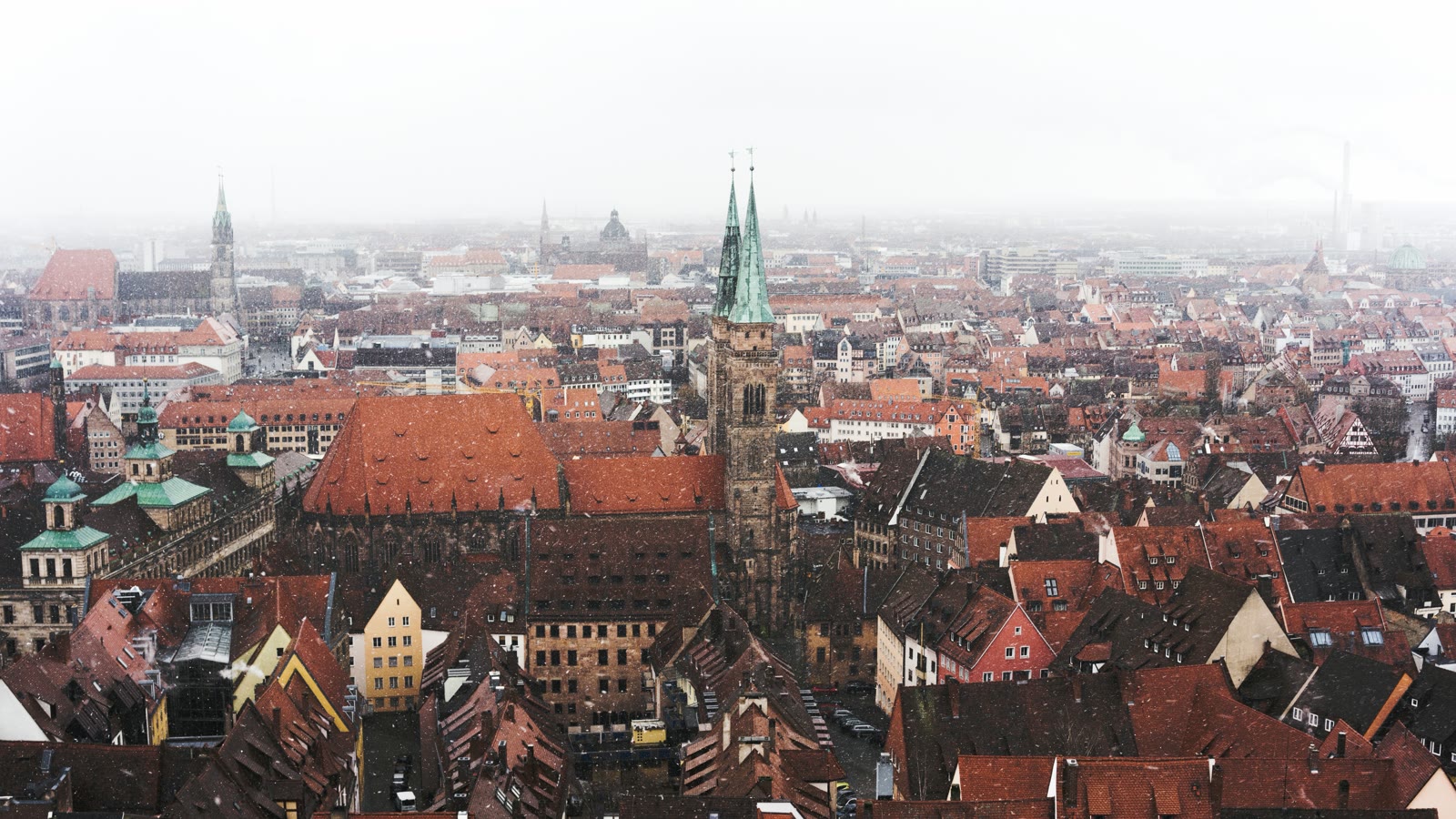
Most visitors arrive at Nuremberg Hauptbahnhof, a 10-minute U-Bahn ride from the airport (U2 line, 3.30 euros), and step directly into the Altstadt. The city’s layout is intuitive: the Pegnitz River splits the old town into St. Sebald (north, castle side) and St. Lorenz (south, museum and shopping side). The 5km circuit of medieval walls has been almost entirely preserved, with four main gates (Frauentor, Spittlertor, Neutor, and Laufer Tor). From the Kaiserburg’s Sinwell Tower, you can see the entire city, the Nuremberg Messe exhibition grounds to the southeast, and on clear days, the hills of Franconian Switzerland 30km to the north.
Nuremberg Weather by Season: A Year-Round Overview
Nuremberg’s continental climate means the city works year-round, but each season delivers a different experience. Spring (March to May) starts cold with lingering frost in March, then warms rapidly: 19°C (66°F) by May with 211 hours of sunshine and beer gardens reopening in mid-April. Summer (June to August) is warm at 22°C to 24°C (72°F to 75°F) with 7 to 8 hours of daily sun, occasional thunderstorms, and the Bardentreffen music festival in late July. Autumn (September to November) begins beautifully at 19°C (66°F) in September, then descends into grey, foggy November with just 47 hours of sunshine and 15 rain days. Winter (December to February) is cold and often snowy, with January averaging 2°C/-3°C (36°F/27°F) and 9 snow days per month, but the Christkindlesmarkt in December makes it the busiest tourist month of the year.
Explore Nuremberg: Complete Travel Guides
We’ve created detailed guides covering every aspect of visiting Nuremberg. Each guide targets a specific travel question with concrete information, from monthly weather data to neighborhood hotel picks with real Booking.com links.
- Nuremberg Weather by Month: temperatures, rainfall, sunshine, and snow data for every month, plus a climate comparison table with historical extremes. Find out which months bring the most snow days and when the beer gardens open.
- Best Time to Visit Nuremberg: crowd calendars, seasonal hotel prices, and the exact weeks to target for the best weather, lowest costs, or specific festivals like the Christkindlesmarkt (December) and Bardentreffen (July).
- Things to Do in Nuremberg: the Kaiserburg, Nazi Party Rally Grounds, Albrecht Durer’s House, Germanisches Nationalmuseum, Nuremberg Zoo, plus day trips to UNESCO-listed Bamberg (40 minutes by train) and medieval Rothenburg ob der Tauber (90 minutes).
- Events and Festivals in Nuremberg: a month-by-month calendar from the Christkindlesmarkt to the free Bardentreffen world music festival, the Altstadtfest, Trempelmarkt flea market, and Klassik Open Air concerts.
- Best Neighborhoods in Nuremberg: the Altstadt’s medieval core, creative GoHo (Gostenhof), leafy St. Johannis, and the history-heavy Sudstadt with practical hotel price ranges and transport connections.
- Where to Stay in Nuremberg: 9 verified hotels across 3 neighborhoods with luxury, mid-range, and budget picks in each, plus Booking.com links for direct reservations.
- Travel Tips and FAQ for Nuremberg: airport transfers (3.30 euros U-Bahn from NUE), public transport passes (8.30 euros day ticket), tipping customs, visa info, safety data, and what to eat (Nurnberger Rostbratwurst, Lebkuchen, and Franconian beer).
Location: Where Nuremberg Sits and What Shapes Its Climate
Nuremberg occupies the Franconian basin in northern Bavaria, 170km north of Munich and 230km southeast of Frankfurt. The city sits at 49.45°N latitude and 309m above sea level. The surrounding Mittelgebirge (low mountain ranges) create a natural bowl that traps cold air in winter, producing temperature inversions where the city sits under fog while hills enjoy sunshine. The Pegnitz River bisects the Altstadt and is a tributary of the Main-Rhine system. The city’s distance from any ocean (450km to the North Sea, 550km to the Adriatic) gives it a fully continental climate with higher seasonal temperature swings than coastal German cities like Hamburg or Bremen.
Nuremberg Quick Facts
- Best months for weather: May, June, and September (18°C to 24°C / 64°F to 75°F, moderate rain, long daylight)
- Warmest month: July (average high 24°C / 75°F, record 38.6°C / 101.5°F)
- Coldest month: January (average high 2°C / 36°F, average low -3°C / 27°F)
- Wettest month: July (70mm / 2.76 inches, 14 rain days)
- Driest month: February (36mm / 1.42 inches, 14 rain days)
- Sunniest month: July (233 hours)
- Annual rainfall: 642mm / 25.3 inches
- Annual sunshine: 1,690 hours
- Snow days per year: 22
- Elevation: 309m / 1,014 feet
Suggested Hotels in Nuremberg
Le Meridien Grand Hotel Nuremberg
The city’s premier luxury hotel directly opposite the Hauptbahnhof, with 192 elegant rooms, marble bathrooms, a spa, and a 14th-floor fitness center. Best for travelers who want 5-star convenience and the ability to drop bags 2 minutes after stepping off the train. Check rates and availability
Karl August – a Neighborhood Hotel
A 75-room boutique hotel on Bahnhofstrasse with floor-to-ceiling windows, rooftop terrace with castle views, and a bright ground-floor cafe serving all-day breakfast. Best for couples and design-conscious travelers wanting a central but characterful stay. Check rates and availability
Five Reasons Hostel and Hotel
A modern hostel-hotel hybrid on Frauentormauer with dorm beds from 22 euros per night and private doubles from 65 euros, a fully equipped guest kitchen, and a lively bar open until midnight. Best for backpackers and budget travelers wanting a social vibe and central Altstadt location. Check rates and availability
