

 Overcast
  Light rain shower
 This post may contain affiliate links. If you purchase through them, I may earn a small commission at no extra cost to you. Thanks for supporting our small business.
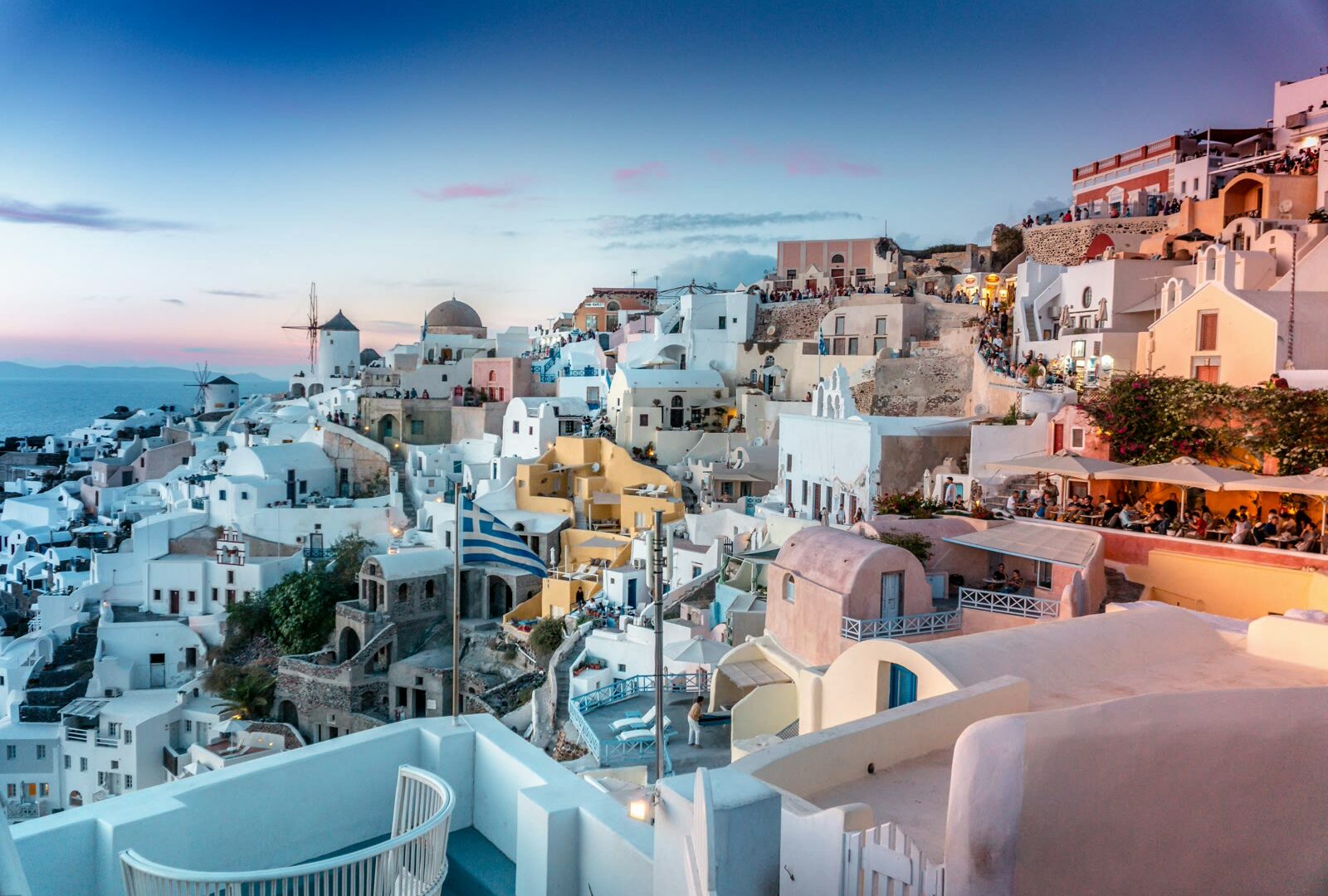
Santorini is the southernmost island of the Cyclades, a crescent-shaped remnant of a volcanic caldera in the Aegean Sea about 200 km southeast of Athens. The island draws over 2 million visitors annually to its whitewashed clifftop villages, black and red sand beaches, and world-famous sunsets. Santorini has a Mediterranean climate with hot, dry summers (see our Santorini weather by month guide for details) (average 29C/84F in July) and mild winters (15C/59F in January). The island gets just 370mm of rain per year, almost all between November and March. The meltemi wind blows from May through September, strongest in July and August, providing natural air conditioning on the caldera side. The sea warms to 24-25C (75-77F) by August, warmer than most Aegean islands thanks to volcanic heating.
Santorini Weather at a Glance
Santorini averages 2,900 hours of sunshine annually, among the highest in Europe. The swimming season runs from June through October (our best time to visit Santorini guide breaks down the best months) (sea temperature 22-25C). July and August are bone-dry with essentially zero rainfall and daytime highs of 30C (86F). The shoulder months of May, June, September, and October offer pleasant temperatures (23-28C / 73-82F) with fewer crowds. Winter (November-March) is mild with temperatures of 15-17C (59-63F) and 7-10 rainy days per month. The meltemi wind peaks in July-August at 30-50 km/h on the caldera side; the eastern beaches (Kamari, Perissa) are more sheltered.
Seasonal Snapshot
- Spring (March to May): Wildflowers blanket the island by April. Daytime highs 17-24C (63-75F), very little rain after March. Easter is the biggest celebration of the year (check our Santorini events and festivals calendar) with candlelit processions and fireworks in Pyrgos. Sea still cool (16-19C).
- Summer (June to August): Peak season. Perfectly dry with 12-14 hours of sunshine daily. Daytime highs 28-30C (82-86F), sea temperature 22-25C. Meltemi wind provides cooling but can be strong (50 km/h gusts). Cruise ships bring 10,000-15,000 day-trippers to Fira daily. Book everything 2-3 months ahead.
- Autumn (September to November): September is the sweet spot: summer-like weather (27C/81F) with warm sea (24C) but fewer crowds. The Ifestia volcano fireworks festival happens mid-September. October is pleasant but rain increases (40mm). Most seasonal businesses close by early November.
- Winter (December to February): Quiet season. Daytime highs 15-16C (59-61F), 7-10 rainy days per month. 60-70% of hotels and restaurants close. Ferry schedules reduce to 1-2 daily. Great for solitude but not a typical Santorini experience.
Explore Santorini
We’ve created detailed guides covering every aspect of visiting Santorini. Start with the weather and best time to visit to pick your dates, then dive into things to do, where to stay, and practical travel tips.
- Santorini Weather by Month: Detailed monthly breakdown of temperatures, rainfall, sunshine hours, sea temperature, and the meltemi wind pattern. Essential reading for picking your travel dates.
- Best Time to Visit Santorini: When to go for the best weather, fewest crowds, lowest prices, and top events including the Ifestia Festival and Orthodox Easter.
- Things to Do in Santorini: Caldera hikes, sunset viewpoints, volcano boat tours, the Red Beach and black sand beaches, Akrotiri archaeological site, winery visits, cooking classes, and day trips to Thirasia and Pyrgos. Covers opening hours, ticket prices, and transport details.
- Santorini Events and Festivals: The complete calendar of religious celebrations (Orthodox Easter), music festivals (Santorini Jazz Festival, Megaron Gyzi, International Music Festival), village panigiria, and the spectacular Ifestia volcano fireworks.
- Best Neighborhoods in Santorini: Where to stay, with detailed profiles of Fira, Oia (see our best neighborhoods in Santorini breakdown), Imerovigli, Firostefani, Kamari, Perissa, Pyrgos, Megalochori, and Monolithos. Covers the character, hotel price ranges, and who each village suits.
- Where to Stay in Santorini: Best areas with specific hotel recommendations across luxury, mid-range, and budget tiers. Includes Katikies, Aressana, Dana Villas, and family-run guesthouses with real Booking.com links.
- Santorini Travel Tips and FAQ: Getting there (flights, ferries), getting around (buses, ATVs, taxis), money, safety, visas, tipping, tap water, accessibility, and practical answers to every question a first-time visitor has (our Santorini travel tips and FAQ guide).
Location and Climate Context
Santorini (officially Thira) sits at 36.4N latitude in the southern Aegean, 200 km southeast of Athens and 140 km north of Crete. The island is part of the Cyclades archipelago. Its horseshoe shape was created by a massive volcanic eruption around 1600 BCE that collapsed the center of the island into the sea, forming the caldera. The volcano is still active (last eruption: 1950) and the two islets in the caldera, Nea Kameni and Palea Kameni, are the youngest volcanic land in the Mediterranean. The island’s climate is shaped by its maritime position, volcanic geology, and the meltemi wind. The eastern side (Kamari, Perissa, Monolithos) is flatter and more sheltered; the western side (Fira, Oia, Imerovigli) drops sharply into the caldera and catches the full force of the meltemi.
Quick Facts
- Best months for weather: June, September (warm, dry, sunny, minimal rain).
- Warmest months: July and August (30C/86F daytime highs).
- Coolest months: January and February (15-16C/59-61F daytime).
- Wettest month: December (78mm, 9 rainy days).
- Sea temperature peak: August (25C/77F).
- Sunniest months: July and August (14 hours/day).
- Best value months: April and October (30-50% lower prices, most businesses open).
- Island size: 76 sq km (29 sq miles). Circumference drive: about 1.5 hours.
- Population: 15,500 permanent residents. 2+ million annual visitors.
- Time zone: Eastern European Time (UTC+2, UTC+3 in summer).
- Language: Greek. English is widely spoken in tourism.
- Airport: Santorini Airport (JTR), 6 km from Fira.
- Main port: Athinios, 8 km from Fira.
Suggested Hotels in Santorini
Katikies Hotel (Oia)
Katikies is Santorini’s most iconic luxury hotel, with whitewashed suites built into the Oia cliffs and three infinity pools that seem to spill into the Aegean. Two restaurants, a spa, and sunset views that rival the famous Oia castle. Best for honeymoons and milestone celebrations. Check rates and availability
Aressana Spa Hotel & Suites (Fira)
Aressana offers a polished hotel experience with pool, spa, and one of the island’s best breakfasts in the heart of Fira, on a quiet street 2 minutes from the main square. An excellent base for exploring. Best for travelers who want comfort and a central location. Check rates and availability
Villa Manos (Karterados)
Villa Manos is a family-run hotel in quiet Karterados, 1.5 km from Fira. Simple, spotless rooms, a pool, and genuinely warm hospitality at 50-90 EUR/night. Best for budget-conscious travelers who want to experience Greek family hospitality. Check rates and availability
