
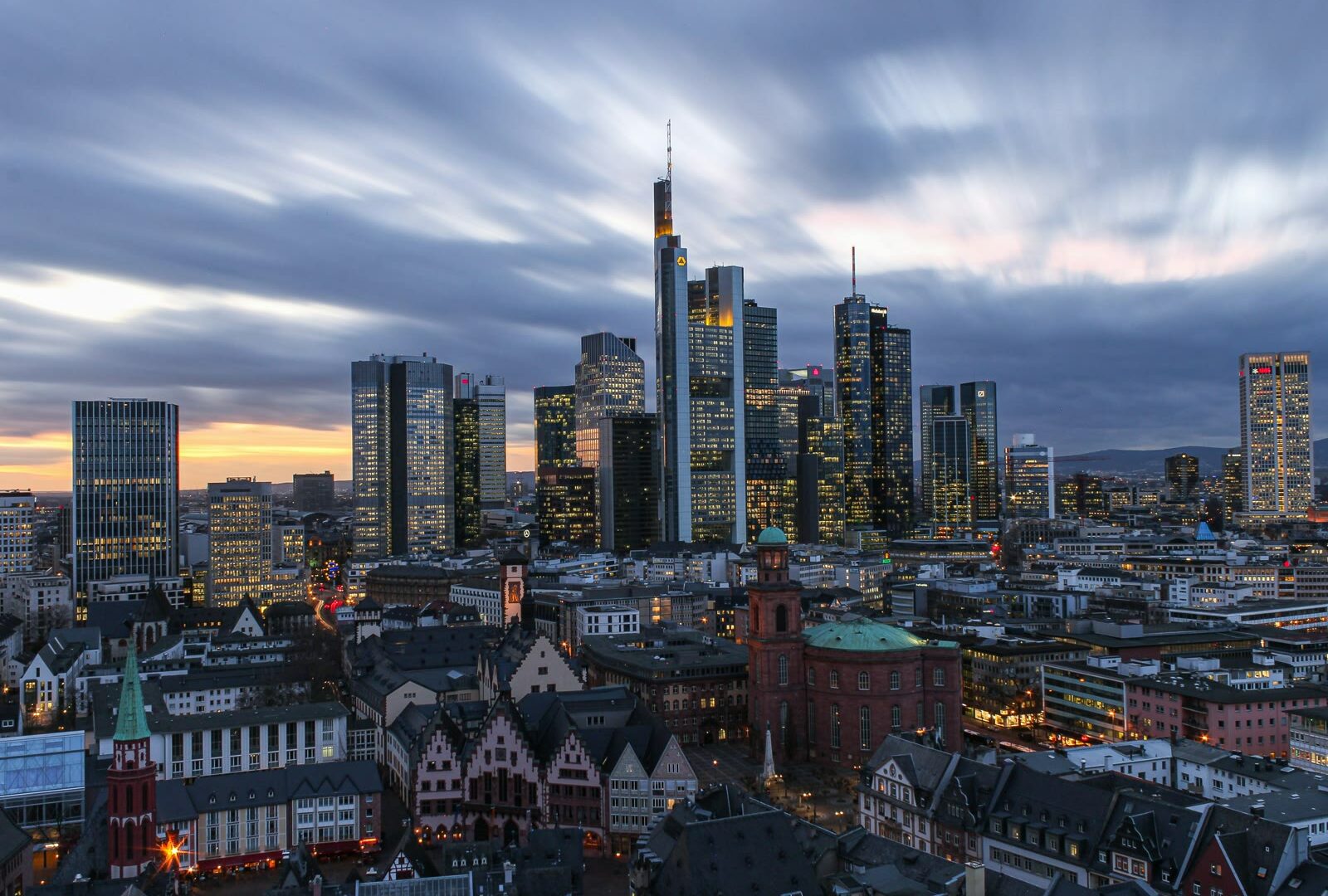

Frankfurt is Germany’s financial capital and its most international city, a place of 760,000 people where glass skyscrapers overlook the half-timbered Römerberg and apple wine taverns serve centuries-old recipes in the shadow of the European Central Bank.
The city receives 1,600 sunshine hours annually and 611mm of rain spread evenly through the year. It’s Germany’s main air hub and the gateway to the Rhine Valley’s castles and vineyards. Unlike Berlin’s sprawling creative scene or Munich’s beer-hall tourism, Frankfurt is compact, efficient, and rewards travelers who look beyond the financial district’s glass towers.
Welcome to Frankfurt: Germany’s Skyline City on the Main
Frankfurt’s unique character comes from its contrasts: the only German city with a true skyscraper skyline (14 of Germany’s 15 tallest buildings), yet also the birthplace of Goethe and the site of Holy Roman Emperor coronations from 1562 to 1792. The city’s walkable core stretches from the Römerberg’s reconstructed medieval square along the Main River to the Museumsufer’s cluster of 16 museums, then south across the Eiserner Steg footbridge to the apple wine taverns of Sachsenhausen.
A complete Frankfurt experience combines a morning at the Städel Museum, lunch at the Kleinmarkthalle gourmet market, an afternoon climbing the Main Tower for skyline views, and an evening over Handkäse mit Musik and tart Ebbelwoi in a wood-paneled Sachsenhausen tavern.
Frankfurt Climate Overview: Mild with Year-Round Rain
Frankfurt has a temperate oceanic climate with continental influence from its position in the Upper Rhine Plain, sheltered by the Taunus mountains. Winters are moderately cold with January highs of 4°C (39°F) and lows of -1°C (30°F). Snow falls roughly 10 days per winter but significant accumulation is rare (2 to 4 times per season).
The main winter challenge is gloom: December provides only 42 hours of sunshine (1.3 hours daily), and grey overcast skies dominate from November through February. Summers are warm rather than hot: July and August both average 25°C (77°F) with 65mm and 57mm of rain respectively, often from afternoon thunderstorms. The city receives 611mm of rain annually spread across 100 to 120 rainy days, with no true dry season.
The most pleasant months are May (20°C / 68°F, 216 sunshine hours), June (23°C / 73°F, 225 hours), and September (20°C / 68°F, 163 hours). These months combine warmth without summer humidity and long daylight hours with sunset after 9:15pm in June. For full monthly data, see the Frankfurt weather by month guide.
Frankfurt Seasonal Snapshot
| Season | Months | Avg High | Rainfall | What to Expect |
|---|---|---|---|---|
| Winter | Dec-Feb | 4-6°C / 39-43°F | 39-56mm | Cold, grey. Christmas market. Lowest hotel prices outside fairs. |
| Spring | Mar-May | 11-20°C / 52-68°F | 45-63mm | Warming. Trade fair season peaks. Parks and gardens bloom. |
| Summer | Jun-Aug | 23-25°C / 73-77°F | 57-65mm | Warm with thunderstorms. Museumsuferfest. Main River comes alive. |
| Autumn | Sep-Nov | 8-20°C / 46-68°F | 50-52mm | September glorious. Book Fair spikes prices. November grey. |
Frankfurt Museums and Attractions
The Museumsufer’s 16 museums, anchored by the Städel Museum (700 years of European art), form the cultural core. The Römerberg and reconstructed Neue Altstadt show Frankfurt’s medieval face. The Goethe House preserves Germany’s greatest writer’s birthplace.
The Main Tower’s observation deck at 198 meters provides the only public skyline view. And the Palmengarten’s 22 hectares of botanical gardens provide a green escape. Our things to do in Frankfurt guide covers every attraction with opening hours, ticket prices, and practical tips.
Frankfurt Events Throughout the Year
Frankfurt’s calendar is driven by the Messe Frankfurt trade fairs, which spike hotel prices dramatically during Ambiente (February), Light + Building (March), IAA Mobility (September, odd years)
the Frankfurt Book Fair (October). Cultural highlights include the Museumsuferfest (August), the Christmas Market (November to December), and the Apple Wine Festival (August). The events and festivals calendar lists every major happening with dates and hotel pricing warnings.
Frankfurt Neighborhoods at a Glance
Frankfurt’s central districts include the Innenstadt (Römerberg, museums, shopping), Alt-Sachsenhausen (apple wine taverns and nightlife), the rapidly changing Bahnhofsviertel (gritty but great dining near the station), and the village-like Bornheim (local markets and cafes). The neighborhoods guide breaks down every district with hotel pricing and atmosphere.
Where to Stay in Frankfurt
Frankfurt hotels range from luxury towers in the Innenstadt to design boutiques in the Bahnhofsviertel and business chains near the Messe. Prices outside trade fairs are reasonable: 4-star rooms from EUR 120 in the center. During fairs, rates triple or quadruple. The where to stay in Frankfurt guide recommends specific hotels at luxury, mid-range, and budget levels for each area.
Suggested Hotels in Frankfurt
Jumeirah Frankfurt
A five-star luxury hotel with rooms from 40 square meters, a spa with indoor pool, and skyline views through floor-to-ceiling windows. Best for luxury travelers wanting Frankfurt’s most prestigious address in the city center. Check rates and availability
Motel One Frankfurt-Römer
A mid-range design hotel with stylish interiors, a rooftop bar overlooking the Römerberg, and reliable quality at EUR 80 to 130 per night. Best for design-conscious travelers wanting a central location with a view. Check rates and availability
Hotel Am Dom
A budget three-star hotel between the cathedral and Römerberg with clean rooms and a medieval-cellar breakfast buffet. Best for budget travelers who want the most central location possible. Check rates and availability
Frankfurt Travel Planning Essentials
The best weather windows are May through June and September. Always check the Messe Frankfurt calendar before booking hotels: trade fairs can make rooms unaffordable or unavailable. Our best time to visit Frankfurt guide includes specific trade fair date strategies.
Frankfurt Airport connects to the city in 11 minutes by S-Bahn (EUR 5.80). ICE trains reach Cologne in 1 hour, Munich in 3 hours 15 minutes. For visas, tipping, safety, and all practical details, see our travel tips and FAQ.
City Articles
Best Time to Visit Frankfurt
July to August: Warm, thundery. Summer fair gap lowers prices. Mainfest and Sommerwerft. September to October: September glorious but IAA spikes prices. Book Fair makes October expensive. November to December: Dark and damp. Christmas market provides festive counterpoint. For neighborhood recommendations and hotel booking advice, see our where to stay in Frankfurt guide and Frankfurt […]
Read MoreFrankfurt Events and Festivals
Frankfurt’s events calendar is shaped by two powerful forces: the Messe Frankfurt trade fair schedule that drives hotel pricing and the city’s traditional festivals rooted in its apple wine culture and medieval history. The biggest events span the traditional (Christmas Market, Dippemess funfair), the cultural (Museumsuferfest), and the commercial (Frankfurt Book Fair, IAA Mobility). Here’s […]
Read MoreFrankfurt Neighborhoods
Frankfurt’s neighborhoods are compact and walkable, with the entire city center fitting within a 3 km radius. The districts divide clearly: the Innenstadt and Bankenviertel for first-time visitors and business travelers, Alt-Sachsenhausen for apple wine and nightlife, Bornheim for a village-within-the-city feel, and the Bahnhofsviertel for red-light grit alongside some of the city’s best restaurants. […]
Read MoreFrankfurt Travel Tips and FAQ
Frankfurt is Germany’s main air hub and one of Europe’s most connected cities. It’s compact, walkable, and efficient, but the trade fair calendar and the Bahnhofsviertel’s red-light edge can catch visitors off guard. This FAQ covers the practical details with specific numbers, station names, and safety advice. Frankfurt Travel Tips: Airport, Transport, Safety, and Practicalities […]
Read MoreFrankfurt Weather by Month
Frankfurt has a temperate oceanic climate with continental influence, giving it moderately cold winters and warm summers. The city receives 611mm of rain annually, distributed fairly evenly throughout the year with a slight summer peak. Frankfurt’s position in the Main River valley creates a microclimate that’s often 1°C to 2°C warmer than surrounding areas. The […]
Read MoreThings to Do in Frankfurt
Frankfurt is Germany’s financial capital, a city of 760,000 people that feels more international and fast-paced than Berlin or Munich. Its skyline of glass towers (nicknamed “Mainhattan”) is unique in Germany, but the city’s cultural depth is often overlooked: an extraordinary cluster of 16 museums along the Main River, a reconstructed medieval old town (the […]
Read MoreWhere to Stay in Frankfurt
Frankfurt’s accommodation market is driven by the Messe convention calendar. Outside trade fairs, the city offers good value compared to Munich or Hamburg, with 4-star rooms in the Innenstadt from EUR 120. During major fairs (Book Fair in October, Ambiente in February, IAA in September), those same rooms hit EUR 350 to 500. This guide […]
Read More