

 Sunny
Sunny This post may contain affiliate links. If you purchase through them, I may earn a small commission at no extra cost to you. Thanks for supporting our small business.
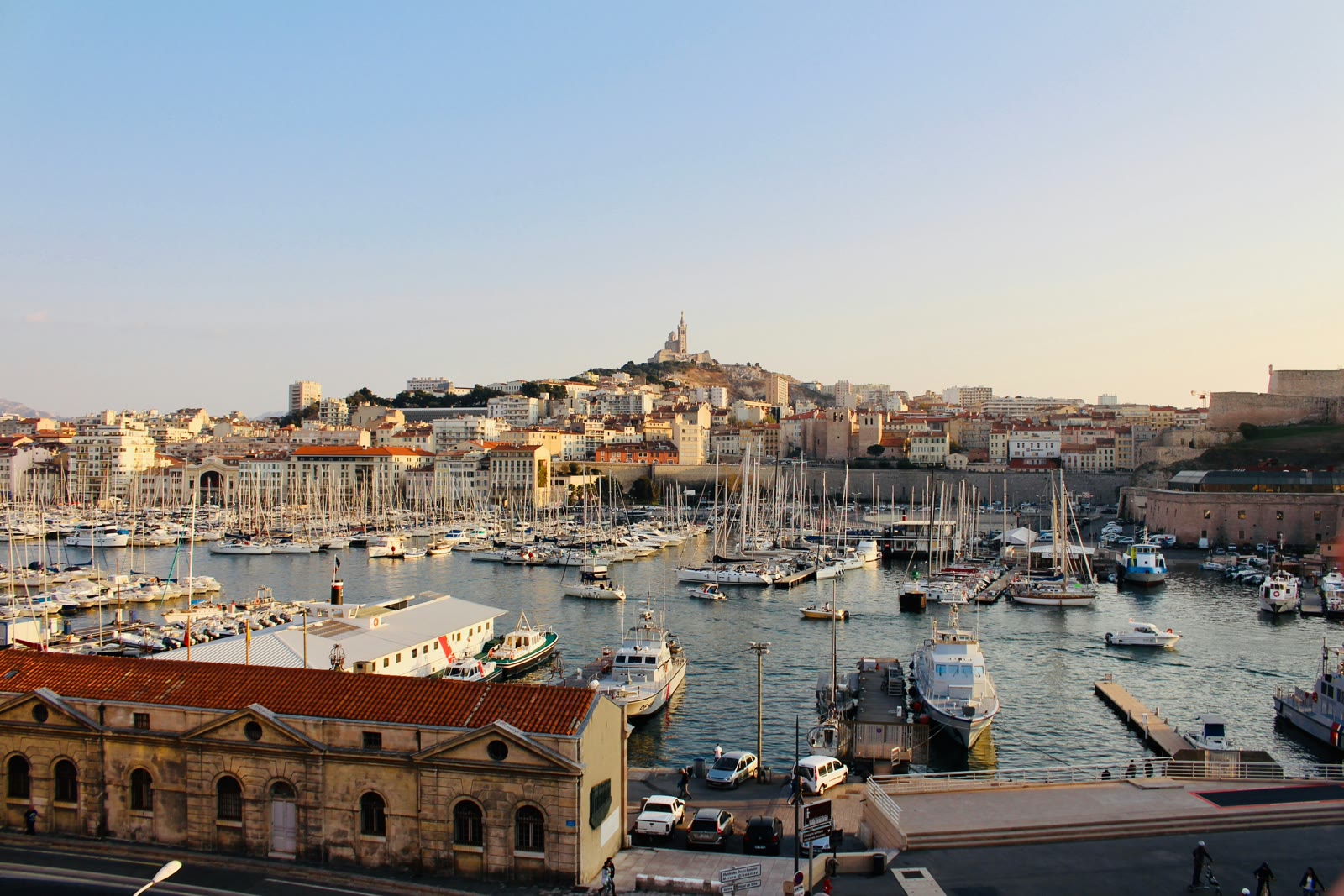
Marseille, France’s second-largest city and its oldest, founded around 600 BC by Greek sailors from Phocaea, is a working Mediterranean port on the edge of the Calanques cliffs. It sits on 240 days of sunshine a year with hot, dry summers and mild winters, tempered by the mistral wind that clears the sky but can blow for days. This Marseille guide covers the climate month by month, the best time to come, and everything worth seeing, staying, and knowing.
Welcome to Marseille
Marseille does not read like the rest of Provence. The port town trades lavender fields for container cranes, and its old quarter, Le Panier, climbs a hill above the Vieux-Port rather than spreading over a plain. The sea is what defines it: the morning fish market on the Quai des Belges, the ferry to the Château d’If, and the white limestone inlets of the Calanques a short bus ride east. In July and August the city runs hot, averaging 29°C (84°F), while January sits around 12°C (54°F) with occasional mistral gusts over 90 km/h (56 mph).
Marseille Weather at a Glance
Marseille has a Mediterranean climate with about 2,800 hours of sunshine and 515 mm of rain a year, most of it falling between October and December. July is the warmest and driest month at 29°C (84°F) with just 8 mm of rain; the sea peaks at 23°C (73°F) in August. Winter is mild and wet rather than cold, with January highs of 12°C (54°F) and lows near 4°C (39°F), and the mistral makes winter days feel sharper than the thermometer suggests.
- Spring (March to May): 16 to 22°C (61 to 72°F), easing rain, and the best season before summer crowds arrive.
- Summer (June to August): 26 to 29°C (79 to 84°F), near-zero rain, warmest sea, and peak hotel prices.
- Autumn (September to November): 16 to 25°C (61 to 77°F), warm sea into October, wet November.
- Winter (December to February): 12 to 13°C (54 to 55°F), light rain, and frequent strong mistral days.
Marseille Travel Guides
These seven guides cover the city in depth, from the month-by-month climate to where to book a room near the port.
- Marseille weather by month: monthly temperatures, rainfall, sunshine hours, and a full sea-temperature table.
- Best time to visit Marseille: the exact months for weather, low prices, fewer crowds, and key events.
- Things to do in Marseille: the Vieux-Port, Notre-Dame de la Garde, MuCEM, and the Calanques.
- Events and festivals in Marseille: from the Fête de la Musique to the Santons Fair.
- Neighborhoods in Marseille: from the old town of Le Panier to the beaches of the 8th.
- Where to stay in Marseille: area-by-area hotel picks with verified recommendations.
- Marseille travel tips and FAQ: airport transport, tickets, tipping, and safety.
Where Marseille Is and What Shapes Its Weather
Marseille fronts the Golfe du Lion on the Mediterranean coast of the Provence-Alpes-Côte d’Azur region, about 300 km south of Lyon and 780 km from Paris. The city wraps around a horseshoe of hills that slope to the Vieux-Port, with the 149-metre hill of Notre-Dame de la Garde at its center and the limestone massif of the Calanques rising to the southeast. Two forces drive the climate: the warm Mediterranean Sea, which keeps winters mild and summers hot but dry, and the mistral, a northerly wind funneled down the Rhône Valley that regularly clears the sky and strips moisture from the air.
Marseille Quick Facts
- Warmest month: July, averaging 29°C (84°F) with 8 mm of rain.
- Coolest month: January, averaging 12°C (54°F) highs and 4°C (39°F) lows.
- Wettest month: October at about 75 mm of rain.
- Sunniest month: July at roughly 350 hours of sunshine.
- Sea temperature: peaks at 23°C (73°F) in August, holds 18 to 21°C into October.
- Annual rainfall: about 515 mm, around half of what Paris receives.
- Airport: Marseille Provence (MRS), 27 km northwest.
- Main station: Marseille Saint-Charles, TGV to Paris in about 3 hrs 15 min.
- Best beach months: June to September, with lifeguards on the Prado beaches.
Suggested Hotels in Marseille
InterContinental Marseille – Hotel Dieu
A five-star occupying an 18th-century hospital building 350 metres from the Vieux-Port, with a terrace restaurant and a heated indoor pool under the historic facade. Best for travelers who want landmark luxury in the historic quarter. Check rates and availability
Radisson Blu Hotel Marseille Vieux Port
A 4-star hotel overlooking the old port with an outdoor pool, a rooftop view, and a sauna in a prime waterfront spot. Best for travelers wanting a pool and a well-known brand by the water. Check rates and availability
ibis budget Marseille Vieux Port
A no-frills central budget hotel behind a 14th-century facade a 10-minute walk from the opera, with breakfast and a bar available. Best for solo travelers keeping costs down in the center. Check rates and availability
