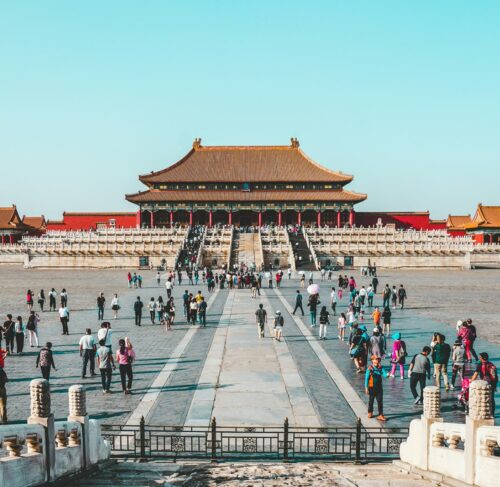
Beijing (北京) is China’s political and cultural capital, home to 21.5 million people spread across 16,410 square kilometers. The city served as the imperial seat for the Yuan, Ming, and Qing dynasties, leaving seven UNESCO World Heritage Sites within its boundaries.
Today it’s a sprawling megacity where Ming dynasty watchtowers stand in the shadow of glass skyscrapers, where breakfast costs 10 CNY at a hutong stall and dinner can run 1,000 CNY at a Michelin-starred Peking duck restaurant in the same neighborhood.
Welcome to Beijing
Beijing operates at a scale that’s hard to grasp from photos. The Forbidden City alone covers 720,000 square meters. The metro system moves 10 million people daily across 27 lines. The city’s ring roads radiate outward from the 2nd Ring (32 km) to the 7th Ring (940 km), which loops through neighboring Hebei province.
You’ll walk more than you expect: a day covering the Forbidden City, Jingshan Park, and the hutongs around Houhai easily clocks 25,000 steps. The metro is efficient and costs 3 to 9 CNY per ride. Taxis start at 13 CNY. Didi, the rideshare app, works in English through Alipay.
The language barrier is real. Outside hotels and major tourist sites, English is rare. Download Pleco for Chinese-English dictionary and a translation app before you arrive. Carry your hotel’s business card with the Chinese address. The city is overwhelmingly safe for violent crime but pickpocketing happens in crowds at Wangfujing and Nanluoguxiang. Air quality fluctuates: October and November bring the clearest skies while winter inversions can push PM2.5 above 300. Pack N95 masks and check the AirVisual app.
Beijing Climate Overview
Beijing has a continental monsoon climate with four sharply defined seasons. Winters (December to February) are cold and dry with January highs around 2°C (36°F) and lows dropping to -9°C (16°F). Snow is rare, averaging 3 to 5 snow days per winter. Spring (March to May) warms rapidly from 12°C in March to 27°C in May but March and April bring Gobi Desert dust storms.
Summers (June to August) are hot and humid with July hitting 31°C (88°F) and humidity at 74%. Most of Beijing’s 570mm annual rain falls in July and August. Autumn (September to November) is the prize: clear skies, 19°C to 26°C temperatures, and only 4 to 7 rainy days per month. The Beijing weather by month guide breaks this down with a full data table.
Seasonal Snapshot: When to Go
The best time to visit Beijing is mid-September through October. Temperatures are comfortable, humidity drops, skies clear, and the autumn foliage peaks at Fragrant Hills. Hotel prices are at their highest during October’s National Day Golden Week (October 1-7), which you should avoid unless you enjoy sharing the Great Wall with 100,000 other people.
November 16 through February brings the lowest prices but temperatures below freezing. July and August are the worst months: heat, humidity, pollution, and domestic summer holiday crowds combine to make sightseeing an endurance test. The first two weeks of December and late February offer the best combination of manageable crowds and reasonable weather outside of peak autumn.
Things to Do in Beijing
The things to do in Beijing guide covers every major attraction with opening hours, ticket prices, and practical tips. The Forbidden City requires online booking 3 days ahead via WeChat.
The Great Wall at Mutianyu has a 1,580-meter toboggan ride down. The Temple of Heaven park fills with 2,000+ locals practicing tai chi at 6:30 AM. The Summer Palace’s Long Corridor runs 728 meters with 14,000 painted scenes. For contemporary Beijing, the 798 Art District houses 200 galleries in a former East German factory complex.
Events and Festivals
Beijing’s events and festivals follow both lunar and Gregorian calendars. Chinese New Year temple fairs at Ditan Park run for 7 days with traditional snacks and acrobatics.
The Mid-Autumn Festival in September fills parks with families eating mooncakes. National Day on October 1 draws over 100,000 to Tiananmen Square for the flag-raising ceremony. The Beijing Marathon in late October takes 30,000 runners from Tiananmen to the Olympic Park. The Dragon Boat Festival in June brings zongzi to every bakery.
Neighborhoods
The Beijing neighborhoods guide breaks down the city by district. Dongcheng holds the imperial core: Forbidden City, Wangfujing, and Nanluoguxiang.
Chaoyang is the business and nightlife hub with Sanlitun’s 200 bars and restaurants. Xicheng offers the most atmospheric hutong stays around Houhai Lake. Haidian, the university district, has cheaper hotels and access to the Summer Palace. Fengtai works for budget travelers near Beijing West Railway Station.
Where to Stay
The where to stay in Beijing guide recommends specific hotels across three areas. Dongcheng suits first-time visitors, Chaoyang works for nightlife and business travelers, and Xicheng delivers the hutong courtyard experience. Each area includes luxury, mid-range, and budget picks with direct Booking.com links.
Suggested Hotels in Beijing
The Peninsula Beijing
All-suite luxury hotel in Wangfujing with 230 rooms starting at 65 square meters, combining Chinese craftsmanship with modern technology. Best for couples and luxury travelers who want a central location. Check rates and availability
Hotel Kapok Beijing
Modern mid-range hotel a 5-minute walk from the Forbidden City with 89 rooms and a rooftop terrace. Best for first-time visitors prioritizing proximity to landmarks. Check rates and availability
Beijing Downtown Travelotel
Budget courtyard hostel inside a restored hutong building on Nanluoguxiang with private rooms and dorm beds from 80 CNY. Best for backpackers and solo travelers wanting an authentic hutong experience. Check rates and availability
Travel Tips and FAQ
The Beijing travel tips and FAQ guide covers airport transport, visa rules including the 144-hour transit policy, payment systems, VPN setup, safety, and language.
Beijing Capital Airport (PEK) connects to the city via the 25 CNY Airport Express train. Beijing Daxing Airport (PKX) has a 35 CNY express link. Most visitors need a tourist visa but 53 nationalities qualify for the 6-day transit exemption. WeChat Pay and Alipay now accept international credit cards. Install a VPN before arriving, Google and WhatsApp are blocked.