

 Partly Cloudy
 Bruges (Brugge in Dutch) is the capital of West Flanders and one of the best-preserved medieval cities in Europe. Its entire historic center, a UNESCO World Heritage site since 2000, is a dense network of cobbled streets, stepped-gable guildhalls, and tree-lined canals that has barely changed since its 15th-century golden age. Located 15 km (9 miles) from the North Sea coast at 51.2 degrees N latitude, Bruges has a temperate maritime climate: cool summers averaging 20 to 22 degrees C (68 to 72 degrees F), mild winters of 2 to 7 degrees C (36 to 45 degrees F), and 820 mm (32 inches) of rain spread across roughly 200 days per year. This guide covers everything you need to plan your visit, from month-by-month climate data to the best canal boat routes and where to sleep inside a 15th-century ducal palace.
Welcome to Bruges
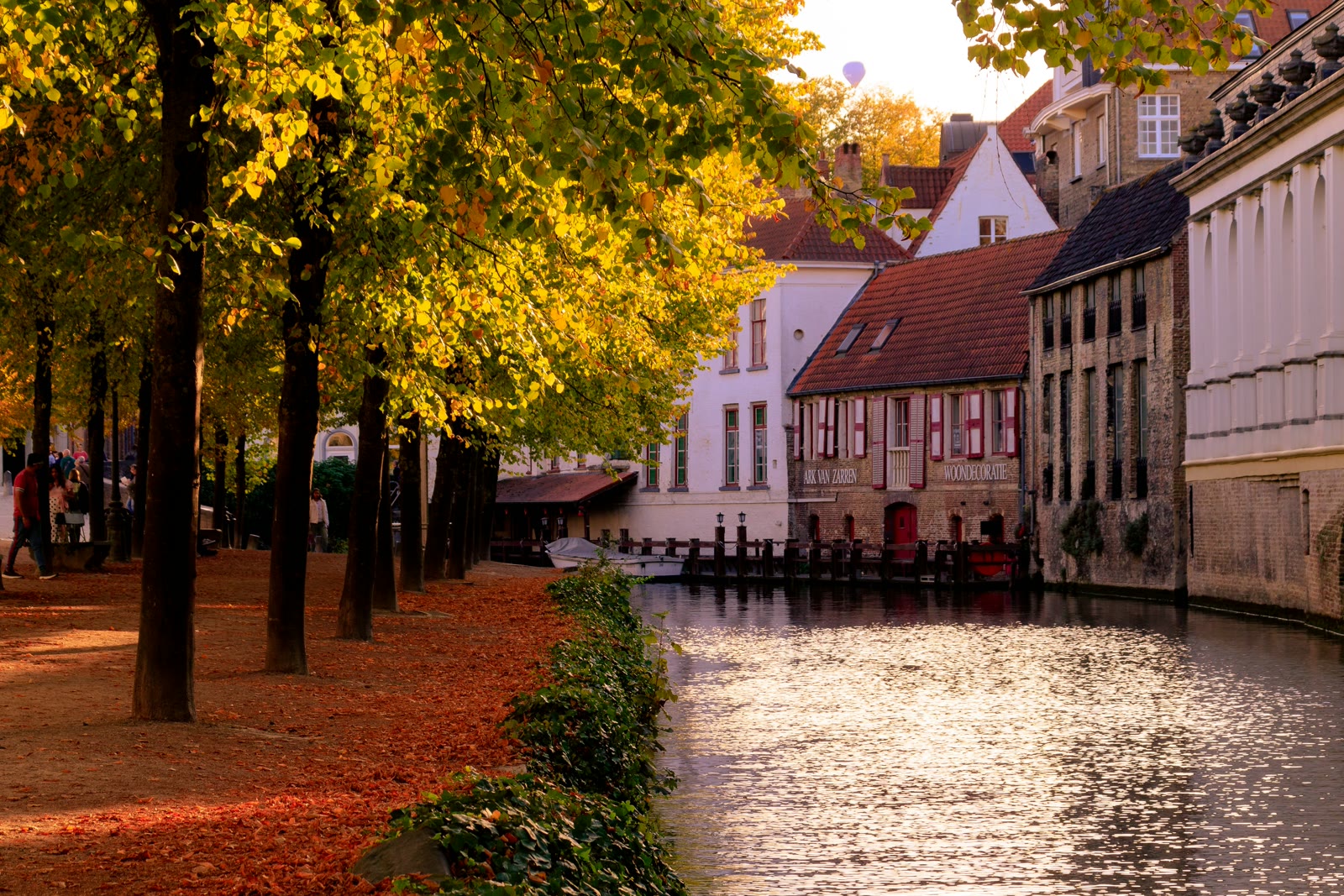
What makes Bruges different from other European tourist cities is that the whole place is the attraction. You do not visit Bruges to see one landmark; you visit to walk the entire medieval circuit. Start at the Markt under the 83-meter Belfry, walk south along the Dijver canal to the Groeningemuseum, cross the Minnewater bridge to the whitewashed Beguinage courtyard, loop back north through the Sint-Anna quarter past windmills and almshouses, and end at a canal-side cafe on the Groenerei as the day-trippers board their buses. The city rewards slow travel: two nights minimum, three to four if you want to cycle to Damme, tour the De Halve Maan brewery, and spend a rainy morning in the Groeningemuseum with the Van Eycks.
Bruges Weather at a Glance
Bruges has a classic Northwest European maritime climate (Koppen Cfb) with no extremes: summers are pleasant rather than hot, winters are chilly but rarely freezing, and rain is frequent but typically light. The city averages 820 mm of annual rainfall across 200 rain days. July and August are the warmest months with average highs of 22 degrees C (72 degrees F) and lows of 13 to 14 degrees C (55 to 57 degrees F). January is the coldest at 2 to 6 degrees C (36 to 43 degrees F). Snow falls on about 10 to 15 days per winter but rarely accumulates beyond a dusting. Sunshine hours peak at 210 in June and bottom out at 45 in December. The North Sea, just 15 km away, moderates temperatures year-round but also brings persistent cloud cover and wind that makes temperatures feel 3 to 4 degrees colder than the mercury suggests.
For a detailed month-by-month breakdown with temperature ranges, rainfall data, and sunshine hours, see our Bruges weather by month guide.
Seasonal Snapshot
- Spring (March to May): Temperatures climb from 3 degrees C to 17 degrees C (37 to 63 degrees F). April is the driest month (45 mm). The Beguinage gardens bloom with daffodils in March and wisteria in late April. The Procession of the Holy Blood takes place on Ascension Thursday in May. Tourist numbers are moderate, and hotel rates are 15 to 25 percent below summer peaks. The best all-around season for sightseeing.
- Summer (June to August): Peak season with highs of 20 to 22 degrees C (68 to 72 degrees F), 14 rain days per month, and 16.5 hours of daylight in June. The Cactus Festival (early July) and MA Festival (early August) bring music to the parks and concert halls. The city fills with day-trippers; the Markt and Burg feel crowded from 11 AM to 4 PM, especially on weekends. Book hotels 2 to 3 months ahead.
- Autumn (September to November): September is the best-value month: 19 degrees C (66 degrees F), thinning crowds, and the Bruges Beer Festival. October brings fall colors along the canals. November is the wettest month (80 mm) with just 60 hours of sunshine, making it the least pleasant for outdoor sightseeing. The Christmas market setup transforms the city from late November.
- Winter (December to February): The Christmas market (Wintergloed) draws 1 million visitors from late November through early January, creating a festive atmosphere with lights, an ice rink, and mulled wine. January and February are the quietest months with the lowest hotel rates (60 to 90 euros for a 3-star). Temperatures average 2 to 7 degrees C (36 to 45 degrees F). Frost on the cobblestones and low winter light make for the city’s most photogenic season, but pack thermal layers and waterproof boots.
Quick Facts
- Best months to visit: May, June, September
- Warmest month: July and August (13 to 22 degrees C / 55 to 72 degrees F)
- Coldest month: January (2 to 6 degrees C / 36 to 43 degrees F)
- Wettest month: November (80 mm / 3.1 inches)
- Driest month: April (45 mm / 1.8 inches)
- Sunniest month: June (210 hours)
- Rain days per year: Approximately 200
- Snow days per year: 10 to 15, light accumulation
- Currency: Euro
- Language: Dutch (Flemish), English widely spoken
- Time zone: CET (UTC+1), CEST (UTC+2) in summer
Plan Your Trip to Bruges
- Bruges Weather by Month – Monthly temperatures, rainfall, sunshine hours, and what to pack for each season.
- Best Time to Visit Bruges – Month-by-month breakdown of weather, events, crowds, and hotel prices to pick your ideal dates.
- Things to Do in Bruges – The Belfry, Groeningemuseum, canal boat tours, De Halve Maan brewery, chocolate shops, and the Beguinage with tickets, hours, and queue-beating tips.
- Events and Festivals in Bruges – Procession of the Holy Blood, Christmas market, Cactus Festival, Bruges Beer Festival, MA Festival, and the Triennial with dates and practical details.
- Neighborhoods in Bruges – Markt and Burg, Sint-Anna quiet canals, the Magdalena shopping quarter, Sint-Gillis for best value, and where each suits.
- Where to Stay in Bruges – Hotel recommendations by area and budget with luxury, mid-range, and budget picks in the Historic Centre, Sint-Anna, and Sint-Gillis.
- Travel Tips and FAQ – Airports, trains, buses, the Musea Brugge card, tipping, safety, languages, and everything you need to know before arriving.
Location and Climate Context
Bruges sits in the flat, low-lying landscape of West Flanders in northern Belgium, 15 km (9 miles) from the North Sea and 25 km (15 miles) from the Dutch border. The city lies at just 2 meters (7 feet) above sea level on reclaimed marshland (the name Bruges likely derives from the Old Norse bryggja, meaning landing stage or harbor). The North Sea exerts the dominant influence on Bruges’s climate, moderating temperatures year-round but also driving the persistent westerly winds and frequent cloud cover that define the local weather. The flat terrain offers no resistance to Atlantic weather systems, meaning rain can arrive suddenly and skies can change multiple times in a single day. For visitors, this translates to one golden rule: always carry a rain jacket, regardless of the morning forecast.
Suggested Hotels in Bruges
Dukes’ Palace Brugge (Luxury)
Five-star hotel in a restored 15th-century ducal palace with 136 rooms, marble bathrooms, historic frescoes, and a private garden courtyard, located 280 meters from the Markt. Best for couples and special occasions. Check rates and availability
Martin’s Brugge (Mid-Range)
Three-star superior hotel 50 meters behind the Belfry with 208 renovated rooms, a terrace, and a cocktail bar, offering the best combination of location and value in the city center. Best for first-time visitors. Check rates and availability
Hotel Botaniek (Budget)
Family-run hotel in the historic centre with breakfast included, an 18th-century building, and a 9.8 out of 10 guest location rating. Best for couples seeking authentic character at an affordable price. Check rates and availability
City Articles
Best Time to Visit Bruges
The best time to visit Bruges is late spring (May to mid-June) and early autumn (September), when daytime temperatures of 15 to 19 degrees C (59 to 66 degrees F) make canal-side walks and museum-hopping comfortable, rainfall is moderate, and crowds are thinner than the July-August peak. May delivers 200 hours of sunshine with 60 […]
Read MoreBruges Events and Festivals
Bruges hosts festivals and events year-round, from a thousand-year-old religious procession to a contemporary triennial art trail. The city’s compact size means most event venues are within a 15-minute walk of the Markt. This guide covers the major annual events with specific dates, locations, and what to expect. For monthly weather and seasonal crowd patterns, […]
Read MoreBruges Neighborhoods Guide
Bruges’s historic center is compact enough to walk across in 20 minutes, but each quarter has a distinct character that can make or break your stay. This guide breaks down the seven main areas: where to stay, what each is known for, and who each suits. For hotel recommendations in each area, see our where […]
Read MoreBruges Travel Tips and FAQ
Bruges is one of Europe’s most visited cities, but its medieval layout and Belgian quirks can trip up first-time visitors. This FAQ covers the practical details: which airport to fly into, how to get from the station to your hotel, what a Musea Brugge card costs, whether you need cash, and a dozen other things […]
Read MoreBruges Weather by Month
Bruges has a temperate maritime climate (Koppen Cfb) with cool summers, mild winters, and rain spread evenly throughout the year. Located at 51.2 degrees N latitude just 8 km (5 miles) from the North Sea coast, the city feels the full influence of Atlantic weather systems that push across the flat Flemish landscape with nothing […]
Read MoreThings to Do in Bruges
Bruges packs more UNESCO World Heritage architecture per square meter than almost any city in Europe. The entire medieval center was inscribed as a World Heritage site in 2000, and the city’s compact size (roughly 2 km across) means you can walk from the Markt to the Beguinage in 15 minutes. This guide covers the […]
Read MoreWhere to Stay in Bruges
Bruges offers accommodation for every budget, from a 15th-century ducal palace turned five-star hotel to family-run B&Bs in step-gabled canal houses. The city’s compact size means almost everything inside the old walls is within a 15-minute walk of the Markt. This guide breaks down the best areas and recommends specific hotels at three price levels. […]
Read More