

 Overcast
  Patchy rain nearby
 This post may contain affiliate links. If you purchase through them, I may earn a small commission at no extra cost to you. Thanks for supporting our small business.
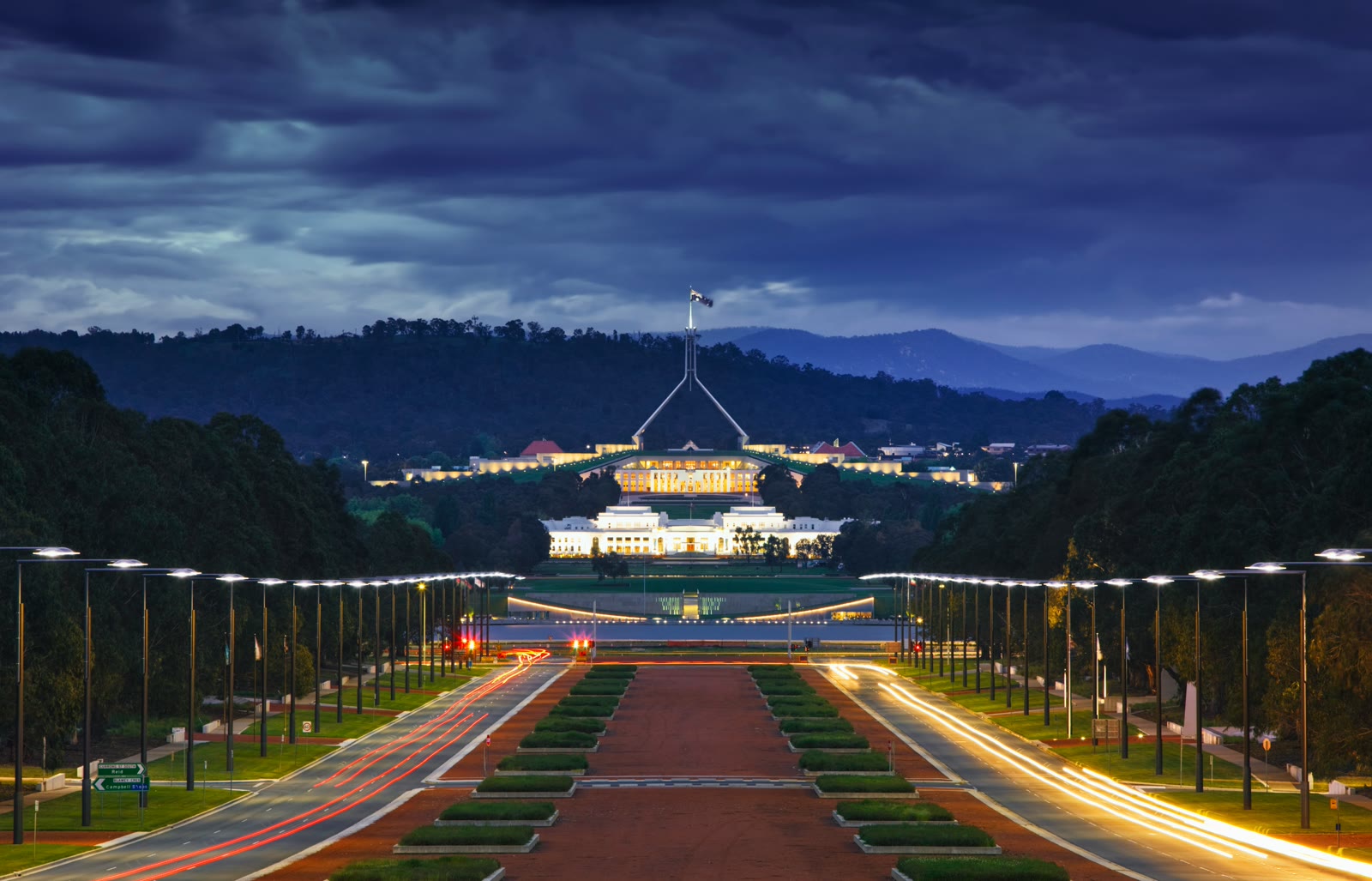
Canberra is Australia’s purpose-built capital, a city of 467,000 people set at 578 metres (1,896 feet) elevation on the Southern Tablelands, 280 km southwest of Sydney and 660 km northeast of Melbourne. It has four distinct seasons with hot, dry summers and cold, frosty winters, a climate shaped by its inland location and altitude. Unlike coastal Australian cities, Canberra experiences an average of 100 frost mornings per year and the highest diurnal temperature range of any Australian capital: a summer day that reaches 35°C (95°F) can drop to 12°C (54°F) overnight. The city is built around Lake Burley Griffin, a 6.6-square-kilometre artificial lake created in 1963, and its national institutions (Parliament House, the War Memorial, the National Gallery, Questacon) are concentrated in the parliamentary triangle on the lake’s southern shore. Most attractions are free to enter, a legacy of Canberra’s role as the national showcase.
Canberra Climate at a Glance
Canberra’s oceanic climate (Köppen Cfb) produces four sharply defined seasons. Summers (December to February) bring daytime highs averaging 27°C to 28.5°C (81-83°F) with heatwaves pushing temperatures above 38°C (100°F) for several days. Afternoon thunderstorms are common, and the UV index sits at extreme (11+) from 10 AM to 4 PM. Autumn (March to May) is Canberra’s showpiece: temperatures settle between 15°C and 25°C (59-77°F), humidity drops, and the city’s 2 million deciduous trees turn brilliant red and gold along Northbourne Avenue and in the parliamentary zone. Winters (June to August) are cold and clear, with daytime highs of 11°C to 13°C (52-55°F) and overnight lows below freezing on most nights. Frost coats the ground on 95 to 100 mornings per year, and fog can delay flights at Canberra Airport until mid-morning. The ski resorts of Perisher and Thredbo are a 2.5-hour drive south. Spring (September to November) warms rapidly but brings wind, changeable weather, and the magpie swooping season.
Canberra Seasonal Snapshot
- Summer (December to February): Hot days (28°C/82°F), cool nights (12°C/54°F), afternoon thunderstorms, UV extreme. Lake Burley Griffin swimming, Christmas quiet period with cheap hotels, bushfire risk on total fire ban days.
- Autumn (March to May): The best season. 15°C to 25°C (59-77°F), low humidity, peak foliage in April, Canberra Balloon Spectacular and Enlighten Festival in March. First frost appears around 20 April.
- Winter (June to August): Cold days (11°C/52°F), freezing nights (-1°C/30°F), 20+ frost mornings per month. Fog delays at Canberra Airport. Ski season at Perisher/Thredbo. Hotel rates drop 30-50%. Indoor attractions dominate.
- Spring (September to November): Warming rapidly (16°C to 24°C / 61-75°F), Floriade flower festival (mid-September to mid-October, 480,000 visitors), magpie swooping season, thunderstorm season begins in October.
Canberra Travel Guides
- Canberra Weather by Month: Temperatures, rainfall, frost days, sunshine hours, and a month-by-month comparison table. Understand Canberra’s four-season climate with specific data from the Bureau of Meteorology.
- Best Time to Visit Canberra: Seasonal recommendations for weather, events, budget travel, and snow access. Includes advice on avoiding parliamentary sitting weeks when hotel prices spike.
- Things to Do in Canberra: Free national institutions (War Memorial, Parliament House, National Gallery, National Museum), outdoor activities on Lake Burley Griffin, and day trips to Tidbinbilla Nature Reserve. Opening hours, ticket prices and transport details.
- Canberra Events and Festivals: Floriade, Enlighten Festival, Canberra Balloon Spectacular, Multicultural Festival, and the National Folk Festival. Dates, locations, ticket prices, and booking advice for each event.
- Canberra Neighborhoods Guide: Civic, Braddon, Barton, Kingston and Manuka: where to stay, eat, and explore in each area. Practical neighbourhood profiles with specific restaurant and hotel recommendations.
- Where to Stay in Canberra: Hotels by area with specific recommendations at luxury, mid-range, and budget tiers. Includes advice on parliamentary sitting weeks and seasonal pricing.
- Canberra Travel Tips and FAQ: Airport transfers, public transport (buses, light rail, bike paths), tipping customs, safety, visa requirements, and practical answers for first-time visitors.
Canberra Location and What Influences the Weather
Canberra sits on the Southern Tablelands at 578 metres (1,896 feet) elevation, roughly 120 km inland from the Pacific Ocean. This inland, elevated position is the key to its climate: the ocean’s moderating influence is blocked by the Great Dividing Range to the east, producing hotter summers and colder winters than Sydney (280 km northeast) or coastal Batemans Bay (150 km southeast). The Brindabella Ranges to the west rise to 1,900 metres and receive reliable winter snow, visible from the city centre. Canberra’s geometric street layout, designed by Walter Burley Griffin in 1913, radiates from Capital Hill in concentric circles and radial avenues, with Lake Burley Griffin as the centrepiece. The city is entirely within the Australian Capital Territory (ACT), a 2,358-square-kilometre enclave carved out of New South Wales in 1911.
Canberra Quick Facts
- Best months to visit: March to May (autumn foliage) and late September to October (Floriade, mild weather)
- Warmest month: January (average 28.5°C/83°F, record 44.0°C/111°F on 4 January 2020)
- Coldest month: July (average high 11.0°C/52°F, record low -10.0°C/14°F on 11 July 1971)
- Wettest month: November (64 mm average)
- Driest month: June (40 mm average)
- Annual rainfall: 620 mm (24.4 inches)
- Frost days per year: 95 to 100 on average
- Sunshine hours: 2,800 hours per year (7.7 hours per day average)
- UV index: Extreme (11+) October to March, low to moderate in winter
- Airport: Canberra Airport (CBR), code CBR, 8 km east of the city centre
- Currency: Australian dollar (AU$)
Suggested Hotels in Canberra
Hotel Realm
5-star all-suite hotel on National Circuit in Barton with 163 suites, a 25-metre indoor pool, day spa, and fine-dining Buvette Bistro. A 10-minute walk from Parliament House in Canberra’s diplomatic quarter. Best for business travellers and couples looking for a full-service luxury stay. Check rates and availability
Crowne Plaza Canberra
296-room hotel on the edge of Glebe Park in Civic, 3 minutes from the light rail terminus and 5 minutes from the Canberra Centre shopping mall. Reliable business-class accommodation with a central location that makes most of the inner city and Braddon dining strip walkable. Best for first-time visitors who want a predictable, well-located hotel. Check rates and availability
Canberra City YHA
Central budget option on Akuna Street in Civic with dorm beds from AU$35 and private doubles from AU$110. Rooftop terrace with lake and mountain views, large shared kitchen, walking distance to the parliamentary triangle and Braddon dining strip. Best for solo backpackers and budget travellers who want to be in the centre of the action. Check rates and availability
