

 Sunny
Sunny  Overcast
 This post may contain affiliate links. If you purchase through them, I may earn a small commission at no extra cost to you. Thanks for supporting our small business.
The Gold Coast is Australia’s sixth-largest city and one of its most visited destinations, stretching 70km along Queensland’s Pacific coastline from Southport to Coolangatta. Known for its surf beaches, theme parks, and subtropical climate with 300 days of sunshine a year, it attracts over 13 million visitors annually. Summer (December to February) brings daytime highs around 28-29°C (82-84°F) and warm ocean temperatures of 26-27°C (79-81°F). Winter (June to August) is mild and dry with daytime highs of 20-22°C (68-72°F), making it one of Australia’s most comfortable winter escapes. The city is backed by the World Heritage-listed Gondwana Rainforest of the Gold Coast Hinterland, where ancient Antarctic beech forests and 100m waterfalls sit just 30-45 minutes from the beach.
Welcome to the Gold Coast
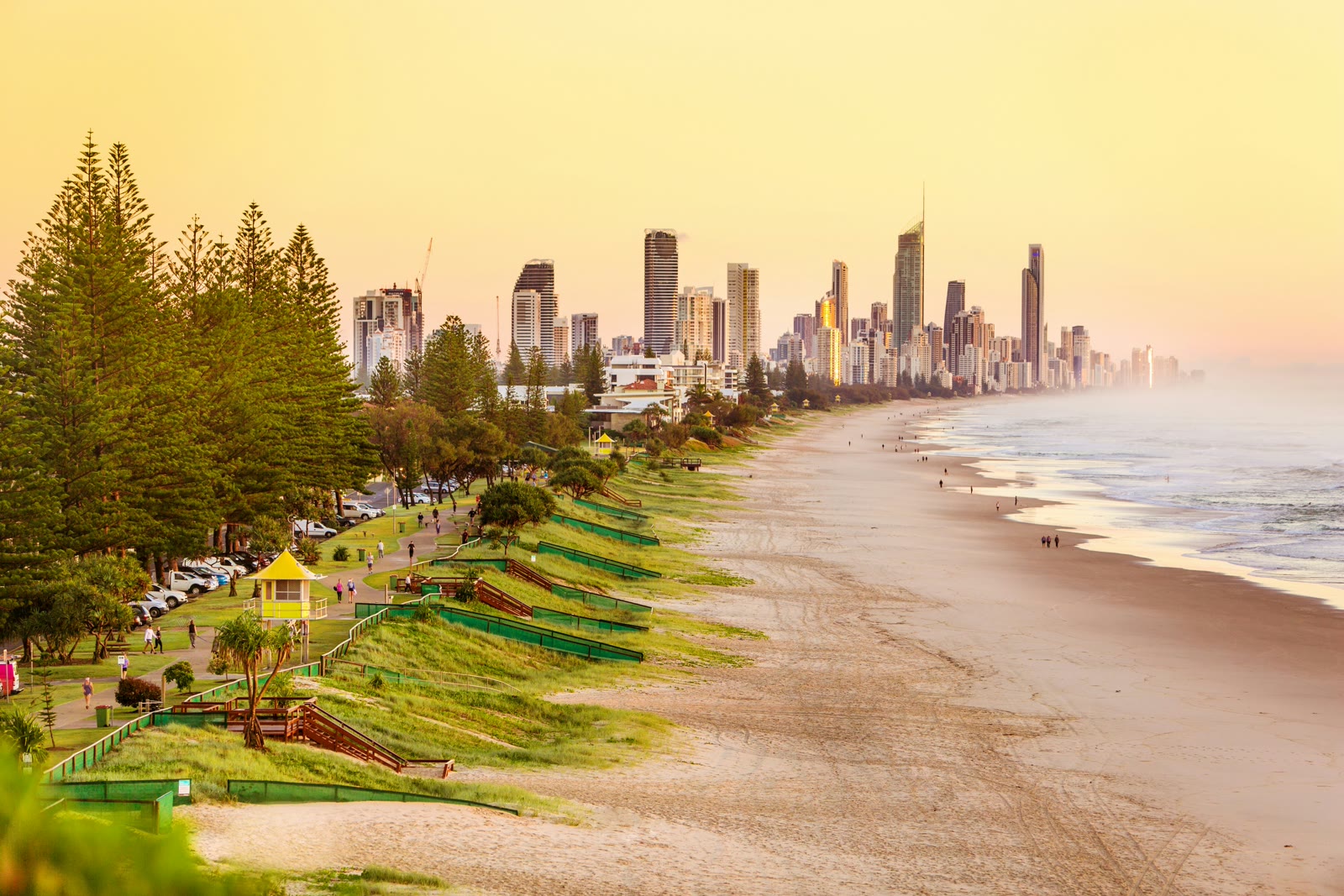
Surfers Paradise is the iconic image of the Gold Coast: a skyline of high-rise apartment towers fronting a 2km stretch of golden sand. But there is a lot more to the coast than its postcard center. The southern end around Burleigh Heads and Coolangatta has a distinctly different character, with a laid-back surf culture, boutique cafes, and some of the best point breaks in the world. The hinterland offers a complete contrast: rainforest walking trails, wineries, and artisan villages on Tamborine Mountain. Between them, five major theme parks including Warner Bros. Movie World, Dreamworld, and Sea World draw families from across Australia and the Asia-Pacific. The Gold Coast Airport at Coolangatta and the G:link light rail system make getting around straightforward without a car, though you will want one for the hinterland.
Gold Coast Climate at a Glance
The Gold Coast has a humid subtropical climate (Koppen Cfa). Summer (December-February) is warm and humid with average highs of 28-29°C (82-84°F), overnight lows around 21°C (70°F), and afternoon thunderstorms that deliver most of the annual 1,215mm of rainfall. Sea temperatures peak at 27°C (81°F). Winter (June-August) is mild and dry with daytime highs of 20-22°C (68-72°F), overnight lows of 10-12°C (50-54°F), and just 42-52mm of monthly rainfall. The shoulder seasons of autumn (March-May) and spring (September-November) offer the best all-round conditions: warm but not hot, low humidity, and significantly fewer crowds than summer. The annual average temperature is 20.4°C (68.7°F), and the city averages over 2,800 sunshine hours per year.
Gold Coast Seasonal Snapshot
- Summer (Dec-Feb): Hot, humid, and the busiest season. Daytime highs 28-29°C (82-84°F), sea 27°C (81°F), afternoon storms. Christmas-New Year is peak pricing; book 6-12 months ahead. Best for: beach holidays, theme parks, swimming.
- Autumn (Mar-May): Transitioning to dry season. Temperatures fall from 28°C to 23°C (82°F to 73°F), humidity drops, and crowds thin after Easter. Blues on Broadbeach music festival in May. Best for: outdoor activities, whale watching (from late April), value-conscious travelers.
- Winter (Jun-Aug): Mild days, cool nights, minimal rain. Highs 20-22°C (68-72°F), lows 10-12°C (50-54°F). World-class surf conditions, peak whale watching, Gold Coast Marathon in July, Bleach Festival in August. Best for: surfers, hikers, budget travelers (lowest accommodation prices).
- Spring (Sep-Nov): Warming up, mostly dry through October. Highs rise from 23°C to 27°C (73°F to 81°F). Gold Coast 600 Supercars in October. November brings the first storms. Best for: beach and outdoor combo trips, events, pre-Christmas holidays.
Gold Coast Quick Facts
- Best months for beach swimming: December to March (sea 26-27°C / 79-81°F)
- Warmest month: January (avg high 28.7°C / 83.7°F)
- Coolest month: July (avg high 20.6°C / 69.1°F)
- Wettest month: February (166mm, 13 rain days)
- Driest month: August (42mm, 6 rain days)
- Warmest sea temperature: January-February (27°C / 81°F)
- Annual sunshine hours: 2,884 (approx 7.9 hours/day average)
- Airports: Gold Coast Airport OOL (Coolangatta, 25km south), Brisbane Airport BNE (90km north)
- Population: ~640,000 (2021 census)
Explore Our Gold Coast Travel Guides
- Gold Coast Weather by Month: A detailed month-by-month breakdown of temperatures, rainfall, sea temperatures, sunshine hours, and what to expect each month. Includes a comparison table with all 12 months side by side.
- Best Time to Visit the Gold Coast: Find the optimal weeks for beach weather, the cheapest months for accommodation, the best surf season, whale watching windows, and a full events calendar to plan around (or avoid) major events.
- Things to Do on the Gold Coast: Covers all five theme parks with ticket prices and hours, the best beaches and surf breaks from Surfers Paradise to Kirra, and the hinterland’s national parks including Springbrook, Tamborine Mountain, and Currumbin Wildlife Sanctuary.
- Gold Coast Events and Festivals: A chronological guide to major events from the Surf Life Saving Championships (March) and Blues on Broadbeach (May) through the Gold Coast Marathon (July), Bleach Festival (August), and the Gold Coast 600 (October).
- Gold Coast Neighborhoods Guide: An area-by-area breakdown covering Surfers Paradise, Broadbeach, Burleigh Heads, Coolangatta, Main Beach, and the hinterland towns. Who each area suits, what you will pay, and how to get around.
- Where to Stay on the Gold Coast: Hotel recommendations across four major areas at three budget tiers, from the JW Marriott in Surfers Paradise to beachfront apartments in Coolangatta. All with verified Booking.com links.
- Gold Coast Travel Tips and FAQ: Airport transfers, public transport (G:link light rail guide), visa requirements, tipping customs, safety, drinking water, theme park pass advice, wildlife encounters, and answers to the most common visitor questions.
Where Is the Gold Coast and What Makes Its Climate Unique?
The Gold Coast sits at latitude 28°S on Australia’s eastern seaboard, 80km south of Brisbane in the state of Queensland. Its subtropical climate is shaped by the warm East Australian Current flowing south from the Coral Sea, which keeps ocean temperatures pleasant year-round and contributes to the summer humidity. The city’s position behind a coastal mountain range (the Great Dividing Range, locally the McPherson Range) creates an orographic rainfall effect: the hinterland receives 2-3 times more rain than the coastal strip, feeding the World Heritage-listed rainforests of Springbrook and Lamington National Parks. Summer thunderstorms develop inland and roll toward the coast in the afternoon, a predictable pattern that means mornings are typically sunny even in the wettest months. Winter brings clear skies, low humidity, and prevailing westerly winds that are offshore for the southern point breaks, creating consistently excellent surf conditions.
Suggested Hotels in Gold Coast
JW Marriott Gold Coast Resort and Spa
Five-star resort in the heart of Surfers Paradise built around a private saltwater lagoon with tropical fish and a sandy beach. Features the Misono Japanese restaurant, a full-service spa, and 223 ocean-view rooms. Best for couples and luxury travelers. Check rates and availability
voco Gold Coast
Four-star IHG hotel a 4-minute walk from Surfers Paradise Beach with two outdoor pools, fitness center, and ocean or hinterland view rooms. Best for couples and business travelers. Check rates and availability
Mantra Legends Hotel
Well-priced four-star hotel 100m from Surfers Paradise Beach with heated pool, spa bath rooms, and on-site restaurant. Best for budget-conscious travelers and families. Check rates and availability
