

 Sunny
Sunny  Patchy rain nearby
  Partly Cloudy
 This post may contain affiliate links. If you purchase through them, I may earn a small commission at no extra cost to you. Thanks for supporting our small business.
Melbourne, Australia’s second-largest city and cultural capital, sits on the northern shore of Port Phillip Bay at latitude 37.8°S with an oceanic climate defined by rapid weather changes. Summer (December-February) brings warm days averaging 24-26°C (75-79°F) with occasional heatwaves pushing past 40°C (104°F).
Winter (June-August) is cool and damp: 14°C (57°F) days, 6°C (43°F) nights, and the most rain days (13-15 per month). Spring (September-November) is the wettest season (October averages 66mm) and the most changeable, with 15°C temperature swings within a single day. Autumn (March-May) offers the most stable weather.
The city receives 600mm of rain annually, spread evenly with no truly dry season. The compact CBD grid, 200+ laneways, three major sporting stadiums, and excellent day trip access (Great Ocean Road, Yarra Valley wineries, Phillip Island penguins) make Melbourne a destination that works in any season if you pack layers.
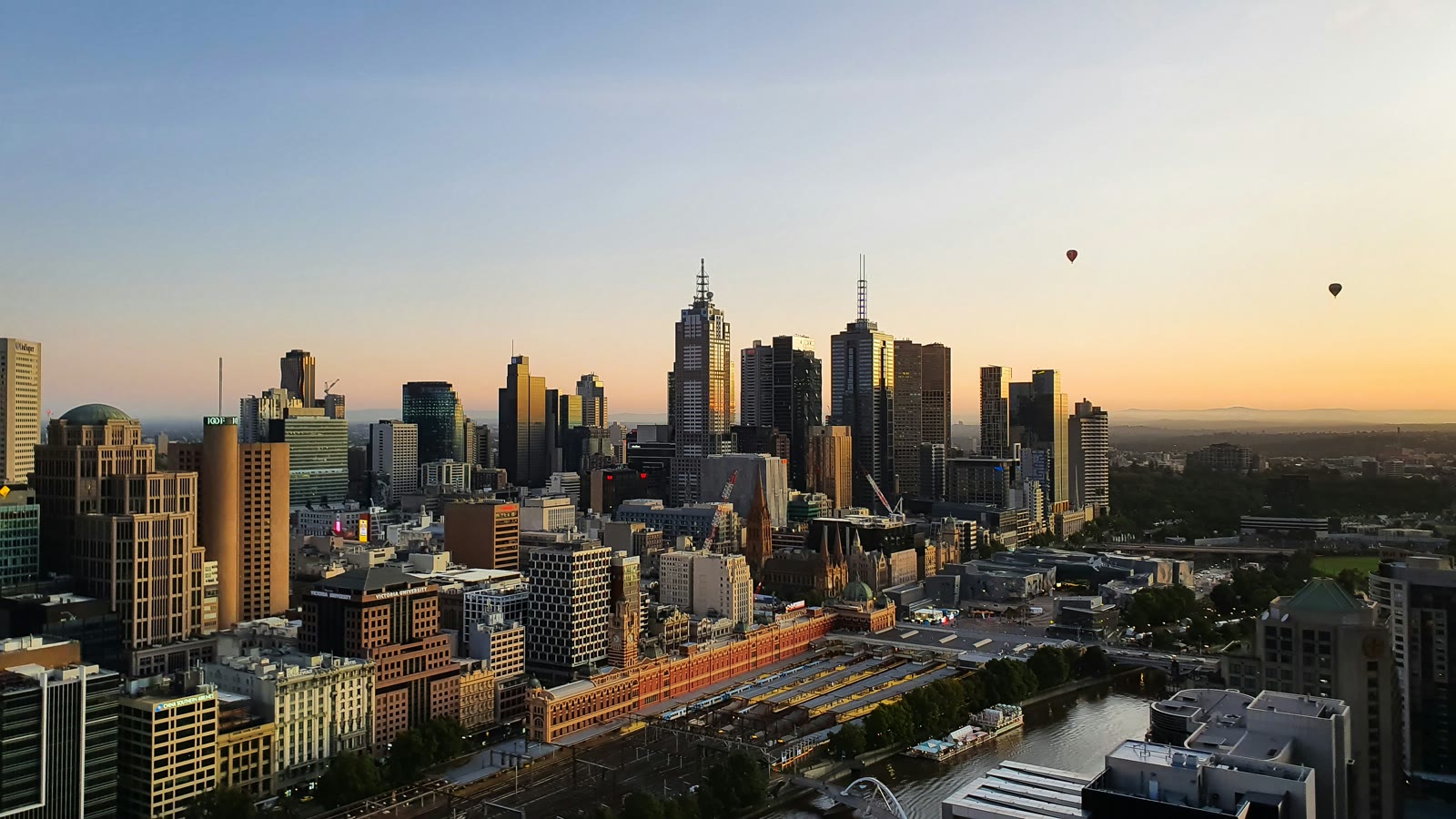
Welcome to Melbourne
Unlike Sydney’s postcard-ready harbor, Melbourne reveals itself slowly through its laneways, rooftops, and neighborhoods. The city operates on coffee (it’s widely considered the specialty coffee capital of the Southern Hemisphere), sport (the MCG seats 100,024 for AFL and cricket), and culture (the National Gallery of Victoria is Australia’s most visited museum, and the Comedy Festival is the country’s largest cultural event).
The free tram zone makes the CBD walkable. A Myki card (AUD 6) unlocks the wider tram and train network with a daily cap of AUD 10.60. Day trips to the Great Ocean Road (4 hours west for the Twelve Apostles), Yarra Valley wineries (1 hour east), and Phillip Island’s penguin colony (90 minutes southeast) are all doable without an overnight stay.
Melbourne Climate and Seasons
Summer (December-February) averages 24-26°C (75-79°F) highs with low humidity (57-59%) and 7-10 rain days per month. Heatwaves spike above 35°C for short bursts. Autumn (March-May) is the most stable: 17-24°C (62-75°F) with 9-13 rain days. Winter (June-August) sees 14-15°C (57-59°F) highs and 6-7°C (43-44°F) lows with 13-15 rainy days per month and just 3-5 hours of daily sun.
Spring (September-November) is the wettest (58-66mm/month) and most changeable. For detailed monthly data including humidity, sunshine hours, and a comparison table, see our Melbourne weather by month guide.
Best Time to Visit Melbourne
February and March offer the best weather with fewer crowds. February averages 26°C (79°F) and March 24°C (75°F), both with acceptable rainfall. The Australian Open (January) and F1 Grand Prix (March) are major event draws. June-August are the worst months for weather but cheapest for hotels.
Avoid the late December to January school holiday peak when domestic tourism surges. For month-by-month analysis including festival dates and price fluctuations, read our best time to visit Melbourne article.
Things to Do in Melbourne
The CBD’s laneways (Hosier Lane for street art, Degraves Street for cafes), the sporting precinct (MCG tours, Australian Open tennis), Queen Victoria Market (since 1878), and the NGV gallery anchor the city. Day trips define the Melbourne experience: the Great Ocean Road’s Twelve Apostles, Phillip Island’s penguin parade, and the Yarra Valley’s wineries.
Each activity has specific seasonal timing and transport requirements. For opening hours, ticket prices, and logistics, see our things to do in Melbourne guide.
Melbourne Neighborhoods
Seven key neighborhoods define the visitor experience. The CBD grid contains laneways and shopping. Fitzroy and Collingwood (northeast) are creative and nightlife hubs. St Kilda (southeast) is the beach and backpacker zone. South Yarra and Prahran (southeast) are upscale shopping. Carlton (north) is the Italian dining and university district.
Southbank stretches along the Yarra with luxury hotels. Each area suits different budgets and travel styles. See our Melbourne neighborhoods guide for boundaries, hotel price ranges, and pros/cons.
Where to Stay in Melbourne
Accommodation ranges from AUD 30 hostel dorms to AUD 800+ luxury suites. The CBD has the broadest selection. Fitzroy offers boutique apartments. St Kilda has the backpacker scene. Southbank targets luxury travelers. For specific hotel recommendations by area with verified Booking.com links, see our where to stay in Melbourne guide.
Suggested Hotels in Melbourne
The Langham Melbourne
Five-star riverside luxury on Southbank Promenade with a day spa, indoor pool overlooking the Yarra River, and the acclaimed Melba Restaurant. Best for couples and luxury travelers who want five-star service within walking distance of the CBD grid. Check rates and availability
QT Melbourne
A design-forward mid-range hotel on Russell Street with industrial-chic rooms, a popular rooftop bar, and the Pascale Bar and Grill on the ground floor. Best for style-conscious travelers who appreciate boutique design in a central CBD location. Check rates and availability
Space Hotel
A budget hybrid on Russell Street offering dorm beds from AUD 35 and private rooms, with a rooftop hot tub, cinema room, and full kitchen facilities. Best for backpackers and budget solo travelers who want hostel atmosphere with hotel-quality amenities. Check rates and availability
Melbourne Events and Festivals
The Australian Open (January), Formula 1 Grand Prix (March), International Comedy Festival (March-April), International Film Festival (August), and Melbourne Cup Carnival (October-November) anchor the annual calendar. For full event dates, locations, ticket prices, and attendance tips, see our Melbourne events and festivals guide.
Melbourne Travel Tips
Melbourne Airport (Tullamarine, MEL) is 23km from town (SkyBus AUD 22). The Myki card system runs trams and trains (AUD 10.60 daily cap, free CBD tram zone). An ETA visa costs AUD 20 for eligible nationalities. Tipping is not expected. Tap water is safe.
For full practical information including transport costs, visa details, safety advice, and FAQs, read our Melbourne travel tips and FAQ.
