

 Smoky haze
 Sunny
 Patchy rain nearby
 Cloudy
This post may contain affiliate links. If you purchase through them, I may earn a small commission at no extra cost to you. Thanks for supporting our small business.
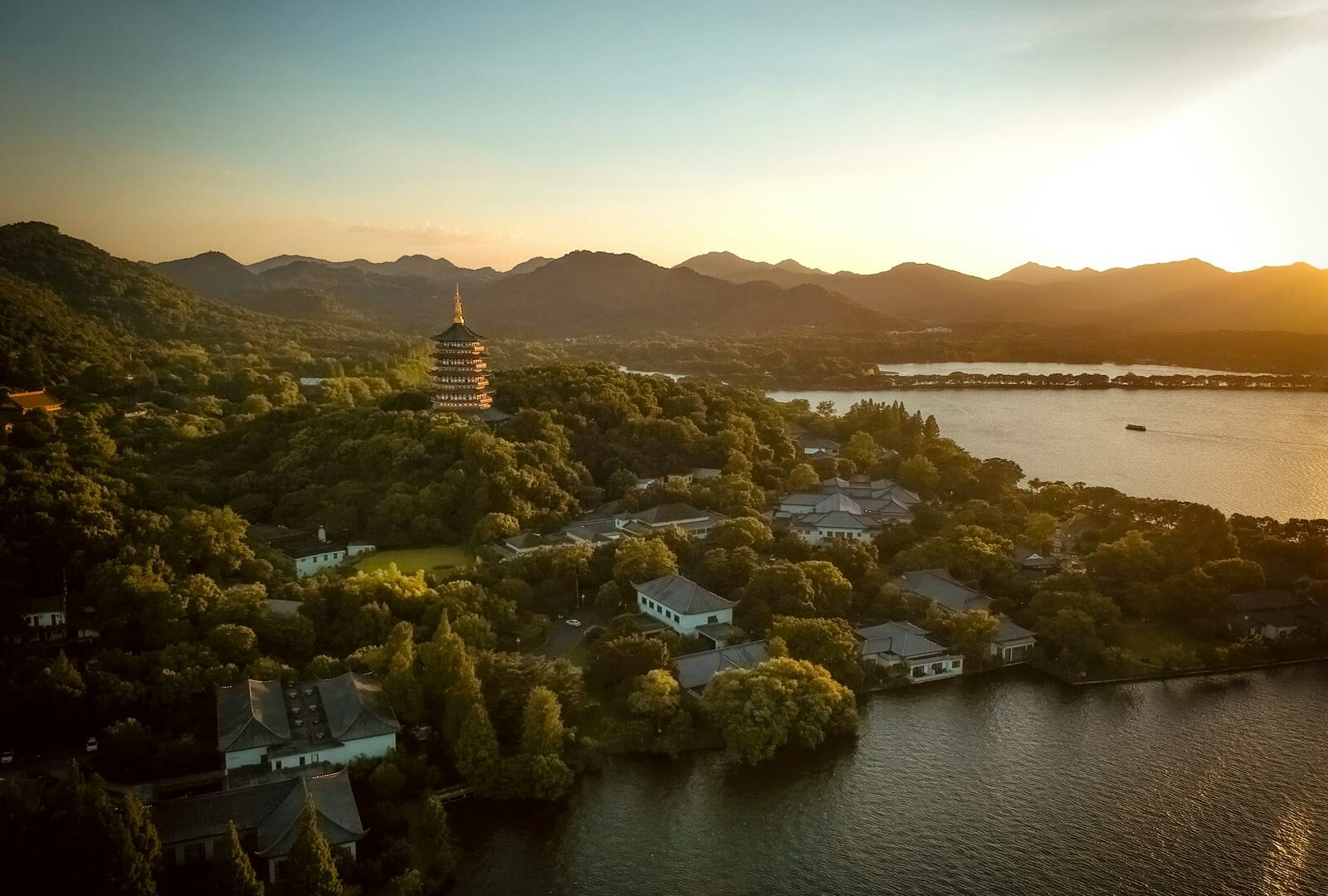
Hangzhou, capital of Zhejiang Province, sits at the southern end of the Grand Canal and the edge of the Qiantang River, just 170km southwest of Shanghai. The city’s identity is inseparable from West Lake, a UNESCO World Heritage site that has inspired Chinese poets, painters, and emperors for over a millennium. Beyond the lake, Hangzhou is a study in contrasts: ancient Buddhist temples hide in forested hills above terraced tea plantations, while across the river, Alibaba’s global headquarters anchors one of China’s most dynamic tech economies. The city’s humid subtropical climate delivers four distinct seasons, from the misty plum rains of June to the brilliant autumn foliage of November, when the osmanthus trees fill the air with fragrance and the tea hills glow gold in the afternoon light.
Welcome to Hangzhou: A City Shaped by Water and Tea
Hangzhou earned its reputation as “Heaven on Earth” during the Southern Song Dynasty (1127-1279), when it served as the imperial capital and ranked among the world’s largest cities with over one million residents. Marco Polo visited in the late 13th century and described it as “the city of heaven, the finest and most splendid in the world.” The city’s layout still follows the logic of its waterways: West Lake anchors the western side, the Qiantang River borders the south, and the Grand Canal threads through the north on its 1,776km journey from Beijing. Modern Hangzhou’s 12 million residents navigate a metro system that connects the historic lakefront to the glass towers of Qiantang New City in under 30 minutes. The juxtaposition is striking: you can spend the morning at a 1,600-year-old Buddhist temple, eat lunch at a tea house overlooking terraces harvested by the same families for six centuries, and attend a business meeting at Alibaba’s Xixi campus before an evening canal cruise.
Hangzhou Climate at a Glance
Hangzhou’s humid subtropical climate (Koppen Cfa) means four well-defined seasons, each with a distinct character. January is the coldest month, averaging 5°C (41°F) with damp, penetrating cold and occasional light snow (1-2 days per year). Spring arrives rapidly: March brings cherry blossoms and the start of the Longjing tea harvest, with temperatures climbing from 14°C (57°F) in March to 26°C (79°F) by May. Summer is hot and wet, dominated by the plum rain season (meiyu) from mid-June through early July when 220mm of persistent drizzle can fall in a single month. July and August peak at 33°C (91°F) with humidity driving the heat index past 40°C (104°F). Autumn is the reward for enduring summer: October averages 23°C (73°F) with just 80mm of rain, and November brings peak fall foliage with crisp, clear days around 17°C (63°F). The city receives roughly 1,450mm of rain annually across 140 rain days, concentrated in the June-July and August-September windows.
Hangzhou Seasonal Snapshot
- Spring (March-May): The city’s most photogenic season. Cherry blossoms at Taiziwan Park peak in late March, tea pickers work the Longjing terraces through April, and Lingyin Temple’s ancient trees leaf out in fresh green. Temperatures climb from 14°C to 26°C. Expect 12-15 rain days per month and pack layers for cool mornings.
- Summer (June-August): Hot, humid, and challenging for outdoor sightseeing. The plum rains (June) deliver weeks of drizzle before the summer heat sets in properly. July and August bring afternoon thunderstorms, lotus blooms on West Lake, and the Dragon Boat Festival. Hotel prices drop outside the July school holiday period. Plan outdoor activities for 6:00-10:00am.
- Autumn (September-November): The best season for visiting. Osmanthus fragrance fills the streets in September, the Qiantang tidal bore peaks around the Mid-Autumn Festival, and October delivers near-perfect weather. The West Lake International Expo runs through October and November. Book accommodation months ahead for Golden Week (October 1-7).
- Winter (December-February): Cold and damp but dramatically quieter. Hotel prices drop 40-60%. Plum blossoms begin at Lingfeng Peak in late February, and a rare snowfall transforms West Lake into the monochrome landscape immortalized in classical Chinese painting. Pack thermal layers and waterproof shoes for the damp cold.
Explore Hangzhou: Complete Travel Guides
- Hangzhou Weather by Month: Complete monthly climate data with temperature averages, rainfall, humidity levels, and sunshine hours. Includes a detailed four-season breakdown with practical packing advice and what to expect in each month.
- Best Time to Visit Hangzhou: Month-by-month analysis of weather quality, crowd levels, and hotel pricing. Covers the three major Chinese holiday periods, the plum rain season, and the optimal windows for tea lovers, photographers, and budget travelers.
- Things to Do in Hangzhou: Detailed guide to West Lake, Lingyin Temple, Leifeng Pagoda, Longjing tea villages, Xixi Wetland, the Grand Canal, Hefang Street, and the China National Silk Museum. Every attraction listed with admission prices, opening hours, and transport directions.
- Hangzhou Events and Festivals: Monthly calendar covering the Qiantang River tidal bore, Longjing Tea Festival, Lingfeng plum blossoms, Dragon Boat races at Xixi Wetland, the West Lake International Expo, and the Osmanthus Festival. Includes practical tips on dates, locations, and prices.
- Best Neighborhoods in Hangzhou: Area-by-area breakdown of West Lake lakeside, Wulin Square, the tea hills, Wushan/Hefang Street, Gongshu District on the Grand Canal, Binjiang tech district, and the Xixi Wetland area. Hotel price ranges and dining tips for each district.
- Where to Stay in Hangzhou: Hotel recommendations across three areas and three budget tiers (luxury, mid-range, budget). Covers the Four Seasons lakeside, Midtown Shangri-La, Amanfayun in the tea hills, and budget guesthouses with Booking.com links.
- Hangzhou Travel Tips and FAQ: Airport transfers, metro navigation, visa requirements, mobile payment setup, VPN/internet access, tap water safety, language tips, and essential phrases. Includes a suggested hotels section with Booking.com links.
Location and Climate Influences
Hangzhou sits at 30°N latitude at an elevation of just 10 meters above sea level, roughly the same latitude as Cairo and New Orleans. The city’s position on the Qiantang River delta, 170km inland from the East China Sea, gives it a moderated coastal climate that lacks the temperature extremes of inland Chinese cities at the same latitude. The surrounding hills to the west (reaching 300-400m) create a rain shadow effect that contributes to the intensity of the plum rain season when moist maritime air masses stall against the topography. The Qiantang River’s funnel-shaped estuary produces the world’s largest tidal bore, with the incoming tide compressed into a wall of water that can reach 9 meters in height as it races upstream at 40 km/h in September.
Hangzhou Quick Facts
- Best months to visit: October and November (mild, dry, autumn foliage)
- Warmest month: July, average 29°C (84°F), highs reach 33°C (91°F)
- Coldest month: January, average 5°C (41°F), lows dip to 2°C (36°F)
- Wettest month: June, 220mm across 15 rain days (plum rain season)
- Driest month: December, 50mm across 9 rain days
- Annual rainfall: 1,450mm across approximately 140 rain days
- Annual sunshine: 1,700 hours (highest in July at 210 hours, lowest in February at 100 hours)
- Humidity range: 73-80% year-round, rarely drops below 70%
- Snow days: 1-2 per year, typically light dustings that melt within hours
- Time zone: China Standard Time (UTC+8), no daylight saving
Suggested Hotels in Hangzhou
Four Seasons Hotel Hangzhou at West Lake
The definitive luxury Hangzhou experience, set on the northwest shore of West Lake in traditional Jiangnan-style gardens with lake-view rooms, indoor and outdoor pools, and an acclaimed Chinese restaurant. Best for couples and luxury travelers seeking a lakefront resort with impeccable five-star service. Check rates and availability
Midtown Shangri-La, Hangzhou
A 5-minute walk from West Lake on Qingchun Road, this reliable international hotel offers spacious rooms, four restaurants, a fitness center with pool, and consistent service standards at roughly half the price of the lakeside luxury resorts. Best for families and business travelers who want location and quality without the top-tier premium. Check rates and availability
Lemon Hotel Hangzhou West Lake
A clean, well-located budget hotel 8 minutes on foot from West Lake with compact but functional air-conditioned rooms, free WiFi, and a location near Ding’an Road metro station that puts you within walking distance of Hefang Street and the lake. Best for solo travelers and backpackers who want maximum location for minimum cost. Check rates and availability
