
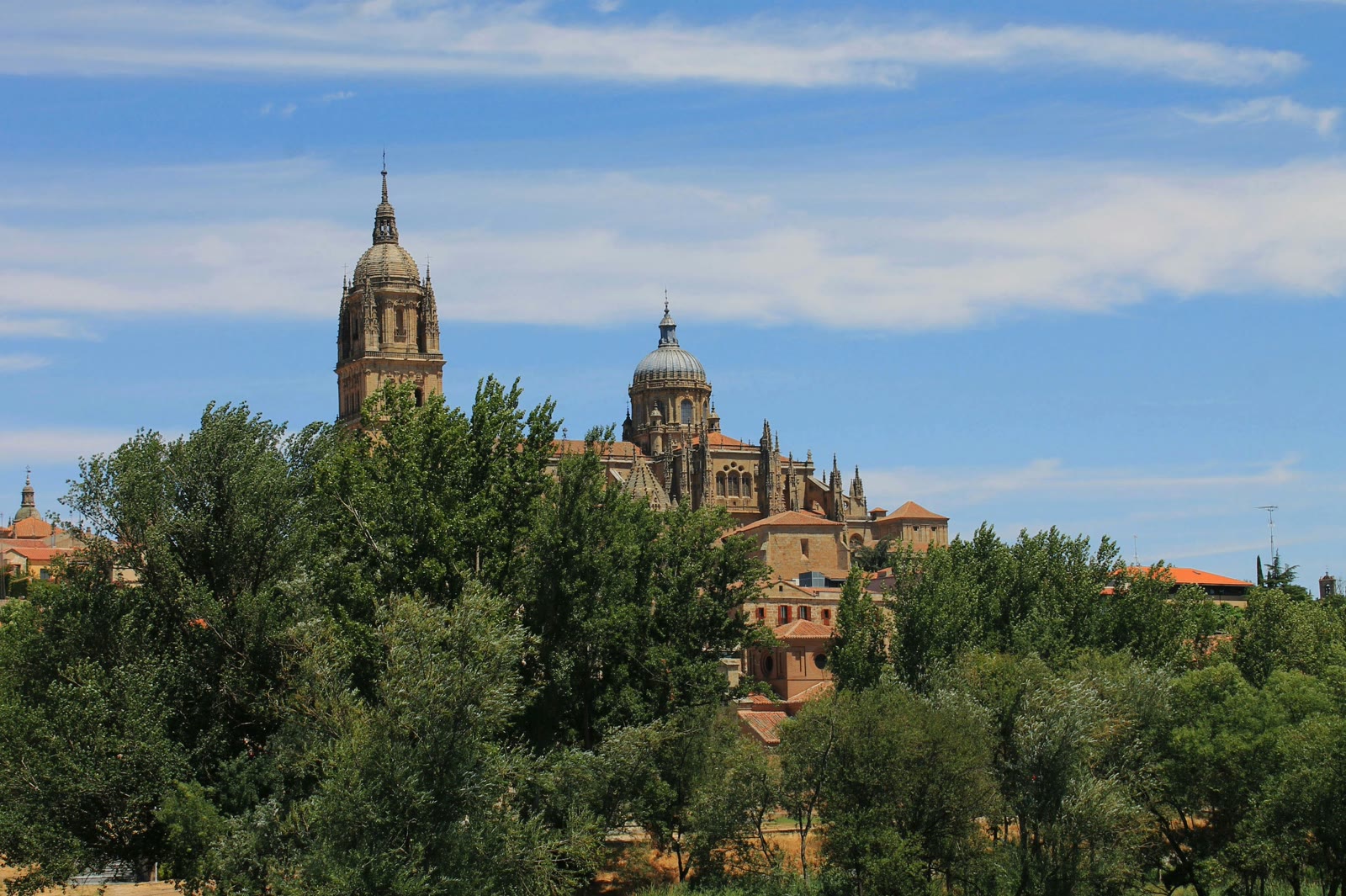

Salamanca, 215km northwest of Madrid on the Castilian plateau, is one of Spain’s most beautiful cities and a UNESCO World Heritage site. Built from warm Villamayor sandstone that glows gold at sunset, the Old Town holds an astonishing density of Renaissance and Baroque architecture anchored by Plaza Mayor, widely considered Spain’s finest main square. The University of Salamanca, founded in 1218, is the oldest university in Spain and the third oldest in Europe still operating, giving the city a youthful energy that balances its historic gravitas. With 144,000 residents, including roughly 30,000 students, Salamanca is compact, walkable, and profoundly Spanish: this is not a city overrun by international tourism but one where you will hear more Spanish than English on the streets.
Welcome to Salamanca: The Golden City of Spain
Salamanca occupies a low rise above the River Tormes at 800 metres (2,625 ft) elevation on the Meseta Central, the vast plateau that defines Spain’s interior. The city’s location shapes everything: summers are hot and dry with temperatures reaching 30C (86F), winters are cold with regular frost and occasional snow, and the shoulder seasons bring the kind of crisp, clear light that made the city’s sandstone monuments famous. The surrounding countryside is classic Castile and Leon: wide horizons, wheat fields, holm oak groves, and fortified villages unchanged for centuries.
What sets Salamanca apart from other historic Spanish cities is its dual identity. By day it is a living museum of Plateresque and Baroque architecture. By night, particularly Thursday through Saturday, the Van Dyck district transforms into one of Spain’s liveliest student nightlife zones, with thousands of students bar-hopping until dawn. This contrast between the solemn and the festive, the ancient and the youthful, is the city’s defining characteristic.
Salamanca Weather at a Glance
Salamanca has a continental Mediterranean climate (Koppen Csa). Winters are cold: January averages 0C (32F) overnight with daytime highs of 9C (48F), and frost is recorded on 30 to 40 mornings per year. Summers are hot and dry: July and August both average 30C (86F) with just 12mm of rain per month and 11 to 12 hours of daily sunshine. The wet seasons are spring (April to May, 40 to 45mm/month) and autumn (October to November, 40 to 45mm/month). Annual rainfall totals about 370mm, low by European standards. The city’s elevation means significant day-to-night temperature swings year-round, typically 12 to 16C between afternoon high and overnight low. For a month-by-month breakdown with temperatures, rainfall, and sunshine hours, see our Salamanca weather by month page.
Seasonal Snapshot
- Spring (March to May): Starts chilly with March frosts, but by May highs reach 21C (70F) and terraces fill up. The wettest season, so pack a rain jacket. The city’s sandstone glows in the spring light and the Lunes de Aguas festival (Monday after Easter) brings the entire city outdoors for riverside picnics.
- Summer (June to August): Hot and almost completely dry. July and August highs of 30C (86F) make midday sightseeing challenging, but evenings at 14C (57F) are perfect for the late-night dining culture. June is milder and the sunniest month with 11 hours of daily sun. UV levels are very high at elevation.
- Autumn (September to November): September stays warm at 26C (79F) but October brings rain and a sharp temperature drop. The Feria de Salamanca (September 8 to 15) is the city’s biggest annual party. November is grey and chilly with the first frosts.
- Winter (December to February): Cold with regular frost overnight and daytime highs of 9 to 12C (48 to 54F). Snow is rare but possible. The Plaza Mayor Christmas market runs through early January. Hotel prices are at their lowest, making this the best season for budget travellers.
For guidance on the ideal months for your trip based on weather, crowds, and prices, read our best time to visit Salamanca guide.
Explore Salamanca: Complete Travel Guides
- Things to Do in Salamanca: From the frog facade at the university to the twin cathedrals, Casa de las Conchas, and the Roman bridge. Includes opening hours, ticket prices, and practical tips for every major attraction.
- Events & Festivals in Salamanca: Plan around Semana Santa processions, the unique Lunes de Aguas picnic festival, June’s FACYL arts festival, September’s Feria, and the student-invented Nochevieja Universitaria in December.
- Salamanca Neighborhoods: A guide to the Old Town (UNESCO historic centre), artsy Barrio del Oeste and its street murals, the student nightlife hub of Van Dyck, and the quiet riverfront San Vicente area.
- Where to Stay in Salamanca: Hotel recommendations by neighbourhood and budget, from a 16th-century convent turned 5-star to modern chain hotels near the train station. Includes suggested hotels in each area.
- Travel Tips & FAQ: Madrid airport transfers, getting around Salamanca, money and tipping customs, safety advice, visa requirements, and the best day trips from the city.
Location and Climate: Why Salamanca’s Weather Matters
Salamanca’s position on the Meseta Central at 800 metres elevation explains its climate. The city is surrounded by flat or gently rolling terrain with no mountains to block weather systems, meaning cold fronts from the north Atlantic sweep through in winter and hot, dry air from the south dominates in summer. The River Tormes runs along the southern edge of the Old Town and provides some moderation: temperatures along the riverbank can be 1 to 2C milder than the exposed Plaza Mayor in both summer and winter. The city’s sandstone buildings absorb heat during the day and release it slowly at night, making narrow streets feel warmer than open squares after sunset.
Quick Facts About Salamanca
- Best months for sightseeing: May, June, and September (21 to 27C / 70 to 81F)
- Warmest months: July and August (30C / 86F average high)
- Coldest month: January (0C / 32F average low)
- Wettest months: April, May, October, November (40 to 45mm each)
- Driest months: July and August (12mm each, 2 rain days)
- Annual rainfall: 370mm (14.5 inches)
- Annual sunshine: Approximately 2,700 hours
- Elevation: 800 metres (2,625 ft) above sea level
- Nearest major airport: Madrid-Barajas (MAD), 215km / 134 miles
- Currency: Euro (EUR)
- Language: Spanish (Castellano)
- UNESCO status: Old Town inscribed 1988
Suggested Hotels in Salamanca
Hospes Palacio de San Esteban (Luxury)
A 5-star hotel in a converted 16th-century convent next to San Esteban monastery in the Old Town. Features an outdoor pool, cloister garden, and restaurant serving Castilian cuisine. Best for couples and luxury travellers seeking historic atmosphere. Check rates and availability
Abba Fonseca (Mid-Range)
A contemporary 4-star on Plaza San Blas, 5 minutes from Plaza Mayor. Rooms feature wooden floors, rainfall showers, and soundproofed windows. The on-site restaurant specialises in regional dishes. Best for travellers wanting Old Town convenience at a reasonable price. Check rates and availability
Hotel Alameda Palace (Upper Mid-Range)
A 5-star property 300 metres from the Old Town with elegant rooms, marble bathrooms, and a terrace bar. Often priced competitively with 4-star hotels. Free WiFi and on-site parking available. Best for those who want luxury touches in a quieter location. Check rates and availability
City Articles
Best Neighborhoods in Salamanca
Salamanca is a compact city of roughly 144,000 residents, with nearly all points of interest clustered within a 30-minute walk of Plaza Mayor. Despite its modest size, the city divides into distinct neighbourhoods, each with a different character, price point, and atmosphere. Here is a guide to the best areas for visitors, from the UNESCO-listed […]
Read MoreBest Time to Visit Salamanca
Salamanca works as a year-round destination thanks to its indoor attractions (cathedrals, university halls, museums), but the experience varies sharply by season. The best overall months are May, June, and September, when temperatures are pleasant at 21 to 27C (70 to 81F), rainfall is moderate, and the city is lively without being overwhelmed. July and […]
Read MoreSalamanca Events and Festivals
Salamanca’s event calendar reflects its dual identity as a historic Castilian city and Spain’s liveliest university town. Religious processions dating back centuries share the streets with student-invented celebrations and a major international arts festival. Here are the key dates to plan around, from Semana Santa to Nochevieja Universitaria. Salamanca Events and Festivals: Complete Annual Calendar […]
Read MoreSalamanca Travel Tips and FAQ
Salamanca is one of Spain’s easiest cities to visit: it is compact, walkable, and geared towards the thousands of international students who arrive each year. But a few practical details make the difference between a smooth trip and a frustrating one. Here is everything you need to know about getting here, getting around, and staying […]
Read MoreSalamanca Weather by Month
Salamanca sits on the Castilian plateau at 800 metres (2,625 ft) above sea level, giving it a continental Mediterranean climate (Koppen Csa) with cold winters and hot, dry summers. The city averages 370mm of rain annually, most concentrated in spring and autumn. Expect sharp temperature swings between day and night year-round: a 30C (86F) July […]
Read MoreThings to Do in Salamanca
Salamanca packs more architectural treasures per square metre than almost any other Spanish city. The entire Old Town is a UNESCO World Heritage site, built from warm Villamayor sandstone that glows gold at sunset. The University of Salamanca, founded in 1218, is the oldest university in Spain and the third oldest in Europe still in […]
Read MoreWhere to Stay in Salamanca
Salamanca’s accommodation ranges from converted 16th-century convents to modern chain hotels, with prices that swing dramatically between peak season (May, September, and festivals) and the winter low season. Most visitors choose the Old Town for its unbeatable location, but Barrio del Oeste and the Gran Via area offer better value. Here is a breakdown by […]
Read More