

 Overcast
  Sunny
Sunny This post may contain affiliate links. If you purchase through them, I may earn a small commission at no extra cost to you. Thanks for supporting our small business.
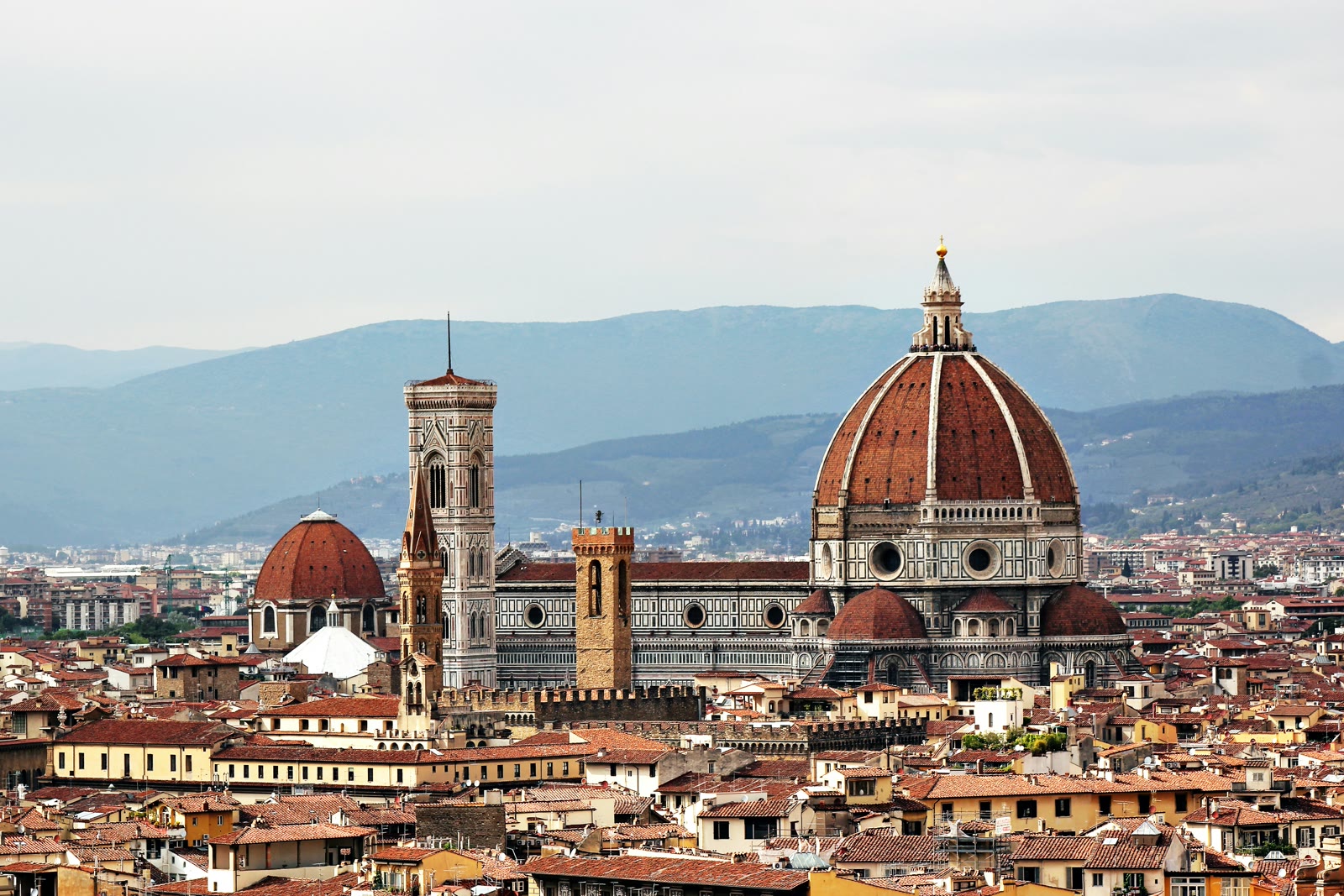
Florence, the capital of Tuscany, is a compact Renaissance city on the Arno River whose historic centre is a UNESCO World Heritage Site packed with the Duomo, the Uffizi and Michelangelo’s David within a walkable core of under 3 square kilometres. The climate is a blend of Mediterranean and continental influences, giving hot, dry summers where July averages 31°C (88°F) and cool, damp winters with January nights around 1°C (34°F). This guide covers the month-by-month weather, the best times to visit, what to do, festivals, neighbourhoods, where to stay and the practical travel details.
Welcome to Florence
The city sits in a valley at about 50 m (164 ft) elevation, ringed by the Fiesole hills to the north, a position that traps heat in summer and moisture in autumn. Winters are mild but grey, springs are bright and settled, and a genuine rainy season builds through October and November, the wettest month at 101 mm. Florence has no true wet season in the tropical sense, but the transition seasons are the most comfortable for walking, and the crowds and prices swing far more than the temperature across the year.
Florence Weather at a Glance
Average highs run from 10°C (50°F) in January to 31°C (88°F) in July and August, with about 66 mm of average monthly rainfall and a yearly total near 770 mm. Sunshine peaks in July at around 11 hours a day and drops to about 3 hours in December. The city is inland enough that heat is dry rather than tropical, but the narrow stone streets can feel several degrees hotter than the official reading in July and August.
Seasonal Snapshot
- Winter (Dec-Feb): Cold and damp, with highs of 10-12°C (50-54°F) and January frosts. The cheapest months, with empty museums and Christmas markets in December.
- Spring (Mar-May): The city blooms and days lengthen; May averages 23°C (73°F) and is arguably the best single month, though prices rise sharply from the winter floor.
- Summer (Jun-Aug): Hot and busy, peaking at 31°C (88°F) in July and August, with the Ferragosto closure on 15 August shutting many independent businesses for the month.
- Autumn (Sep-Nov): A golden September at 26°C (79°F) gives way to the year’s wettest stretch, with November logging 101 mm, but autumn also brings the harvest and truffle season.
Florence Travel Guides
- Florence weather by month: Full month-by-month temperatures, rainfall and sunshine data with a comparison table.
- Best time to visit Florence: Which months offer the best weather, lowest prices and fewest crowds, and which to avoid.
- Things to do in Florence: The Duomo dome, Uffizi, David and the Oltrarno, with hours, prices and queue-beating tips.
- Florence events and festivals: The Scoppio del Carro, Calcio Storico and the Christmas markets, with dates and venues.
- Florence neighborhoods: A district-by-district breakdown of the Duomo core, Santa Croce, the Oltrarno and Fiesole.
- Where to stay in Florence: Three areas with three specific hotels each, from riverside palaces to station-side hostels.
- Florence travel tips and FAQ: Airports, transport costs, tipping, safety and the answers to the questions travellers ask most.
Where Florence Sits and What Shapes Its Weather
Florence lies in central Tuscany in the Arno valley, which runs west to the Tyrrhenian Sea about 80 km away and is sheltered by the Apennines to the east. That position gives it warmer, sunnier summers than coastal Tuscany and cooler winters than the coast, with the surrounding hills concentrating heat in the centre. The valley also means fog and damp mornings in late autumn, one reason November feels colder than its 14°C (57°F) average high suggests.
Florence Quick Facts
- Best months to visit: May and September for weather, January and February for low prices and empty museums
- Warmest month: August, average high 31°C (88°F)
- Coldest month: January, average low 1°C (34°F)
- Wettest month: November at 101 mm of rain
- Driest month: July at 32 mm of rain
- Elevation: about 50 m (164 ft) above sea level
Where to Stay in Florence
Florence’s centre splits neatly into the historic core around the Duomo and Ponte Vecchio, the quieter Oltrarno across the river and the budget station district. Each has hotels at every tier, and prices move far more with the season than with distance from the Duomo. The full where to stay in Florence guide pairs each area with three specific hotels.
Suggested Hotels in Florence
The St. Regis Florence
A 15th-century palace on the north bank of the Arno with frescoed ceilings, a Michelin-starred restaurant and dedicated butler service. Best for couples and travellers marking an occasion who want classic luxury near the Ponte Vecchio. Check rates and availability
Hotel Brunelleschi
A restored medieval tower and Byzantine church beside the Duomo, with parquet-floor rooms, a private museum and cathedral views. Best for first-time visitors who want the centre at a mid-range price. Check rates and availability
Aurora Garden Lodging
A well-rated bed and breakfast near Santa Maria Novella station with garden access and comfortable, good-value rooms. Best for budget travellers and early-train day-trippers. Check rates and availability
