

 Sunny
Sunny  Smoky haze
 This post may contain affiliate links. If you purchase through them, I may earn a small commission at no extra cost to you. Thanks for supporting our small business.
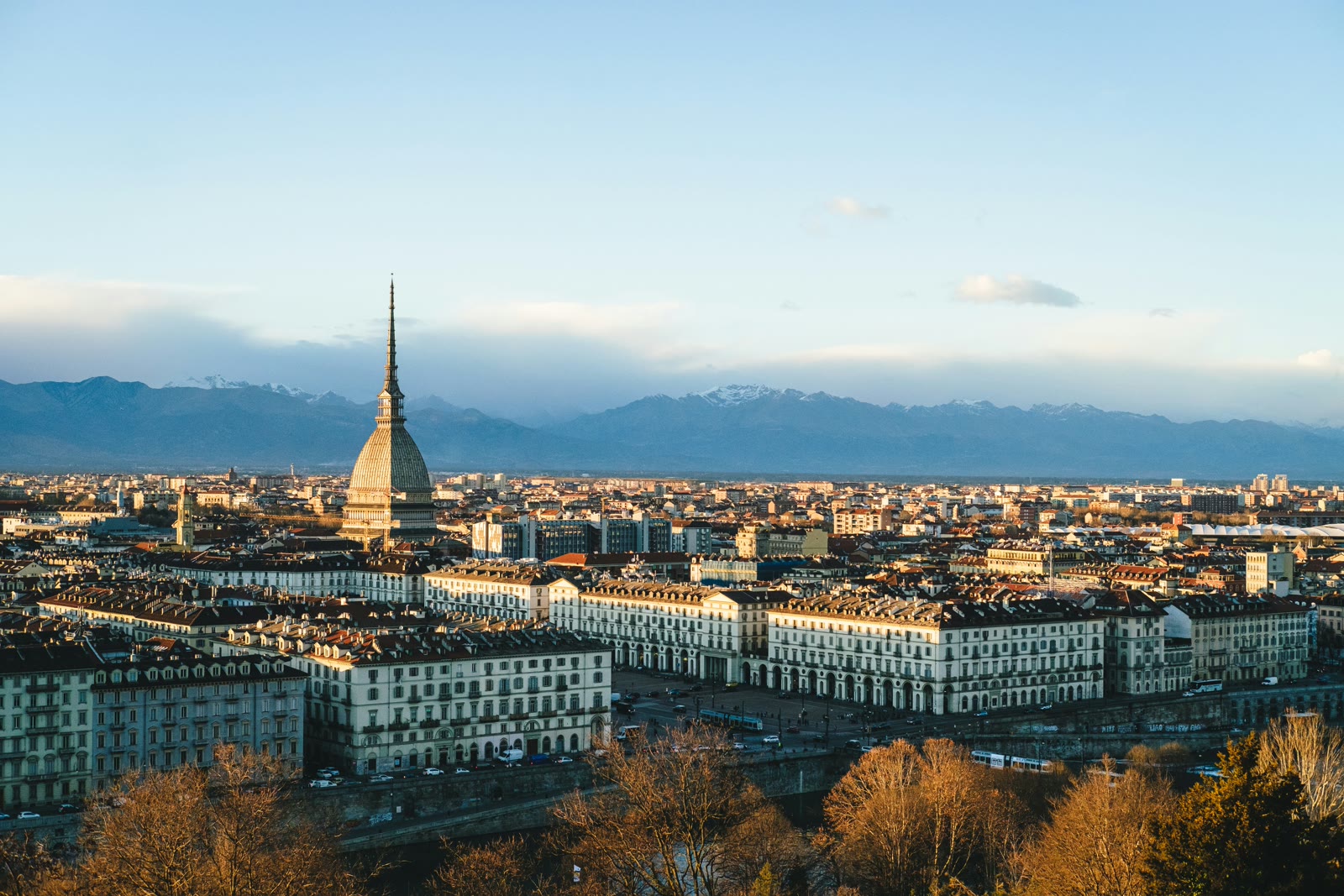
Turin, the capital of Italy’s Piedmont region, is a city of 850,000 people set at the foot of the Alps in the Po Valley. It was Italy’s first capital from 1861 to 1865, the seat of the House of Savoy for four centuries, and the birthplace of Italian cinema, the automobile industry (Fiat was founded here in 1899)
gianduja chocolate, the ancestor of Nutella. Unlike Rome, Florence, or Venice, Turin doesn’t feel overrun by tourism. It feels like a wealthy, functional northern Italian city where people actually live, work, and eat well, with 18 km of arcaded porticoes making it walkable in any weather.
Welcome to Turin: Italy’s First Capital Under the Alps
Turin rewards travelers who come for the culture and stay for the food. Mornings are for the Egyptian Museum, the world’s second-largest collection of Egyptian antiquities after Cairo. Afternoons are for the Royal Palace and the Mole Antonelliana’s panoramic lift, which on clear days reveals the Alps spanning the entire western horizon.
Evenings are for a bicerin (layered espresso, chocolate, and cream) at an unchanged 1763 cafe, followed by agnolotti del plin (tiny pinched pasta parcels) at a trattoria in the Quadrilatero Romano, Turin’s ancient Roman grid turned food and nightlife district. The Porta Palazzo market, Europe’s largest open-air market, fills the northern edge of the Quadrilatero six days a week with 800 stalls of produce, cheese, meat, and everything else.
Turin Climate Overview: Fog, Heat, and Alpine Influence
Turin has a humid subtropical climate with strong continental influence from its position in the Po Valley, ringed by the Alps to the north and west. Winters (December to February) are cold and foggy, with January averaging 7°C (45°F) daytime and 0°C (32°F) nighttime.
The city averages 50 foggy days per year, concentrated between November and February, when visibility can drop below 200 meters until mid-morning. Snow falls occasionally (2 to 5 days per winter) but rarely accumulates for more than 24 hours in the city center. The Alps, however, receive heavy snow, making Turin one of the few major European cities with world-class skiing under 90 minutes away at Sestriere and Bardonecchia.
Spring (March to May) is unpredictable: March can deliver 18°C (64°F) one afternoon and 5°C (41°F) the next morning. May is Turin’s rainiest month at 103mm. Summer (June to August) brings heat that’s amplified by the Po Valley’s basin geography: July averages 29°C (84°F) with sticky humidity, and August sees many local businesses close for 1 to 2 weeks around Ferragosto (August 15).
Autumn (September to mid-November) begins beautifully with September’s 23°C (73°F) and golden light before sliding into October’s rains and November’s fog. The city receives 770mm of rain annually. For detailed monthly data, see the Turin weather by month guide.
Turin Seasonal Snapshot
| Season | Months | Avg High | Rainfall | What to Expect |
|---|---|---|---|---|
| Winter | Dec-Feb | 7-9°C / 45-48°F | 37-43mm | Cold, foggy. Skiing nearby. Christmas markets and Luci d’Artista in December. |
| Spring | Mar-May | 14-22°C / 57-72°F | 53-103mm | Unpredictable. May is wettest month but warm enough for outdoor dining. |
| Summer | Jun-Aug | 26-29°C / 79-84°F | 48-73mm | Hot and sticky. Many businesses close in August. Outdoor cinema and music. |
| Autumn | Sep-Nov | 11-23°C / 52-73°F | 68-88mm | September is ideal. October rains. November fog returns. Truffle season. |
Turin Museums and Attractions
Turin’s cultural lineup starts with the Museo Egizio, the world’s second-largest Egyptian collection (40,000 artifacts), followed by the Mole Antonelliana’s National Cinema Museum with its glass panoramic lift, the Royal Palace and adjacent Galleria Sabauda art gallery, and the automobile museum inside the former Fiat Lingotto factory.
The UNESCO-listed Savoy Residences ring the city, and the hilltop Superga Basilica provides the best panoramic view. The Torino+Piemonte Card (EUR 35 for 2 days, EUR 42 for 3 days) covers entry to all major museums plus public transport. Our things to do in Turin guide covers every major attraction with opening hours, ticket prices, and practical tips.
Turin Events Throughout the Year
Turin’s events calendar is anchored by the Salone del Libro book fair (mid-May, 150,000 visitors), the ATP Finals tennis championship (mid-November), the Terra Madre Salone del Gusto food festival (late September, biennial), and the Luci d’Artista light installations (November to January).
Chocolate lovers time visits for Cioccolatò (late October to early November). The Turin events and festivals calendar lists every major event with dates and practical planning details.
Turin Neighborhoods at a Glance
Turin’s neighborhoods divide clearly: the monumental Centro Storico around Piazza San Carlo for first-time visitors and museum-goers, the ancient Quadrilatero Romano for food and nightlife, multicultural San Salvario for the best restaurants and bar scene, residential Crocetta for quiet elegance, and the post-industrial Lingotto district for conference attendees and business travelers.
Each area has distinct hotel pricing, restaurant density, and noise levels. The Turin neighborhoods guide breaks down every district with boundaries, atmosphere, and who it suits.
Where to Stay in Turin
Turin accommodation spans from grand five-star palazzi in the Centro Storico to boutique B&Bs in San Salvario and modern chain hotels in Lingotto. The where to stay in Turin guide recommends specific hotels at luxury, mid-range, and budget price points for each neighborhood with real Booking.com links.
Suggested Hotels in Turin
Grand Hotel Sitea
A five-star luxury hotel on Via Carlo Alberto in a 1920s palazzo with a private garden courtyard, classic rooms with parquet floors and marble bathrooms, and the excellent Piedmontese restaurant Il Carignano. Best for luxury travelers who want quiet, old-world service a short walk from Piazza San Carlo and the Egyptian Museum. Check rates and availability
NH Collection Torino Piazza Carlina
A mid-range four-star hotel in a restored 17th-century building on Piazza Carlo Emanuele II, with a rooftop terrace, spa, and rooms larger than the Centro average at 28 to 35 square meters. Best for couples who want central location with modern comforts in a quiet, elegant piazza. Check rates and availability
Hotel Due Mondi
A budget-friendly three-star hotel on Via Saluzzo at the edge of the Centro and San Salvario, with clean, functional rooms and a generous breakfast buffet included. Best for budget-conscious sightseers who want a central location without paying Centro premiums. Check rates and availability
Turin Travel Planning Essentials
The best weather windows are late April through June and September through mid-October, when temperatures sit between 17°C and 26°C (63°F to 79°F). Our best time to visit Turin guide breaks down every month with weather ratings, price data, and event timing.
Turin Caselle Airport (TRN) connects to the city center in 40 minutes by train (EUR 4.90) or 50 minutes by bus (EUR 7). High-speed trains reach Milan in 50 minutes and Rome in 4 hours. For all practical details from visas to tipping to safety, see our Turin travel tips and FAQ.
