

 Sunny
Sunny  Overcast
  Partly Cloudy
 This post may contain affiliate links. If you purchase through them, I may earn a small commission at no extra cost to you. Thanks for supporting our small business.
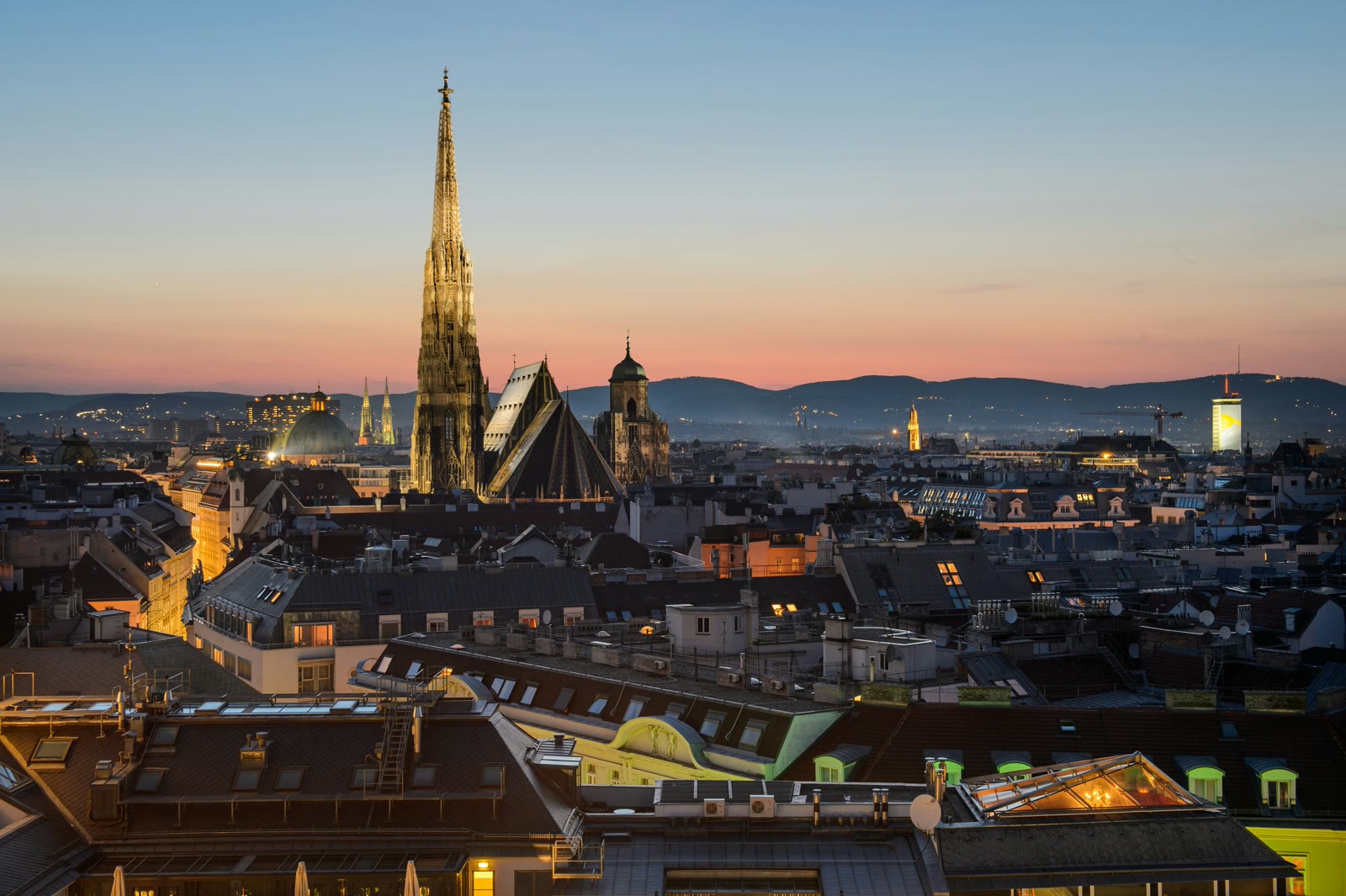
Vienna, Austria’s capital, sits on the Danube River at the eastern edge of the Alps where the Vienna Basin meets the Pannonian Plain. The city’s climate is a transitional mix of oceanic and continental, giving it four distinct seasons: cold grey winters, vibrant springs, warm and occasionally humid summers, and crisp golden autumns. With roughly 620mm of precipitation annually, Vienna is noticeably drier than the alpine regions to the west, though it still sees snow on 15-20 days per winter.
Vienna Weather at a Glance
Vienna’s position between the Vienna Woods and the Pannonian Plain shapes its weather. The hills to the west moderate winds; the plain to the east funnels hot air in summer and biting cold in winter. January temperatures average 3C to -3C (37F to 27F) with snow on 9 days. July and August peak at 26C (79F) with heatwaves above 33C (91F) possible for 10-15 days per summer. Rain falls year-round but peaks in June and July (70-72mm) as afternoon thunderstorms. Sunshine ranges from 51 hours in December to 257 hours in July. The urban heat island effect keeps the Innere Stadt 3-5C warmer than outlying districts in summer and marginally warmer in winter.
Seasonal Snapshot
- Spring (March to May): March starts cool at 11C (52F) but May reaches 21C (70F) with 238 hours of sunshine. Park magnolias and cherry blossoms peak in April. Outdoor cafe (Schanigarten) season begins March 1 and is in full swing by mid-April. The Easter markets run for two weeks before Easter Sunday.
- Summer (June to August): Warm at 24-26C (75-79F) with 234-257 hours of sunshine per month. The Danube Island Festival (late June) is Europe’s largest free music event. The free Music Film Festival at Rathausplatz runs July-August with nightly outdoor screenings. Heatwaves push temperatures above 33C (91F); the Danube Island lidos are the escape.
- Autumn (September to November): September delivers 21C (70F) and golden light perfect for Heurigen wine tavern visits in Grinzing and Neustift. October is cooler (15C / 59F) with spectacular Vienna Woods foliage. November is the greyest month at just 66 hours of sunshine, but Christmas markets open from mid-month.
- Winter (December to February): Cold (highs 3-4C / 37-39F) with snow on 7-9 days per month. The Christmas markets run mid-November to December 26, peaking at Rathausplatz with 150+ stalls. Ball season runs January-February with roughly 450 formal balls. Hotel rates hit annual lows in January (excluding ball weekends).
Vienna Travel Guides
Our detailed Vienna guides cover every aspect of planning your trip, from month-by-month climate data to neighbourhood breakdowns, complete event calendars, and honest hotel recommendations:
- Vienna Weather by Month: Complete climate data with monthly temperature, rainfall, sunshine, and snow day tables.
- Best Time to Visit Vienna: Season-by-season breakdown with specific date ranges for Christmas markets, ball season, best weather, lowest crowds, and cheapest prices.
- Things to Do in Vienna: Every major palace, museum, church, and attraction with opening hours, ticket prices, and practical tips.
- Vienna Events and Festivals: The complete annual calendar from Christmas markets to ball season to summer festivals.
- Best Neighbourhoods in Vienna: District-by-district guide to Innere Stadt, Neubau, Wieden, Leopoldstadt, Dobling and more.
- Where to Stay in Vienna: Area-by-area hotel recommendations with luxury, mid-range, and budget picks for every district.
- Vienna Travel Tips and FAQ: Airport transfers, transport passes, coffee house etiquette, tipping, visas and all practical information.
Quick Facts
- Country: Austria | Federal State: Vienna (Wien)
- Population: 2 million (city), 2.9 million (metro area)
- Language: German (English widely spoken in tourism)
- Currency: Euro (EUR)
- Time zone: CET (UTC+1) / CEST (UTC+2) March-October
- Best months for weather: May, June, September. See full breakdown
- Warmest month: July/August (26C / 79F average high)
- Coldest month: January (3C / 37F high, -3C / 27F low)
- Annual precipitation: 620mm, spread year-round
- Airport: Vienna International (VIE), 18km southeast, 16 minutes by CAT train
Where Is Vienna?
Vienna is in northeastern Austria, 60 kilometres from the Slovak border and 80 kilometres from the Hungarian border. The city sits on both banks of the Danube River at the easternmost foothills of the Alps. Vienna International Airport (VIE) is in Schwechat, 18 kilometres southeast of the city centre, reachable by the City Airport Train (CAT, 16 minutes, 14.90 euros) or the S-Bahn S7 (25 minutes, 4.30 euros). The city’s 23 districts spiral outward from the 1st District (Innere Stadt), bounded by the Ringstrasse boulevard, a UNESCO World Heritage site along with the Schonbrunn Palace and the historic centre. Vienna is the second largest German-speaking city after Berlin and the cultural and economic heart of Austria.
Suggested Hotels in Vienna
Hotel Sacher Wien
The 1876 grand hotel behind the State Opera and home of the original Sacher-Torte. Rooms are furnished in antiques and silk, the Rote Bar serves a legendary beef tartare, and the Blaue Bar is the city’s finest pre-opera cocktail spot. Best for luxury travellers who want an irreplaceable piece of Viennese history and a location opposite the Opera. Check rates and availability
25hours Hotel at MuseumsQuartier
A circus-themed design hotel with 217 rooms facing the MuseumsQuartier, a rooftop bar with 360-degree city views, and free-to-use Mini Coopers. The 1500 Foodmakers restaurant serves excellent Italian dishes. Best for mid-to-high-range travellers who want a vibrant design hotel in the cultural quarter. Check rates and availability
Wombat’s City Hostel Vienna – Naschmarkt
Vienna’s top-rated hostel directly on the Naschmarkt with dorm beds from 22 euros, private rooms from 65 euros, a courtyard garden, guest kitchen, and lively basement bar. Best for budget backpackers and solo travellers who want a social atmosphere at hostel prices in a perfect central location. Check rates and availability
