

 Overcast
  Patchy rain nearby
  Sunny
Sunny This post may contain affiliate links. If you purchase through them, I may earn a small commission at no extra cost to you. Thanks for supporting our small business.
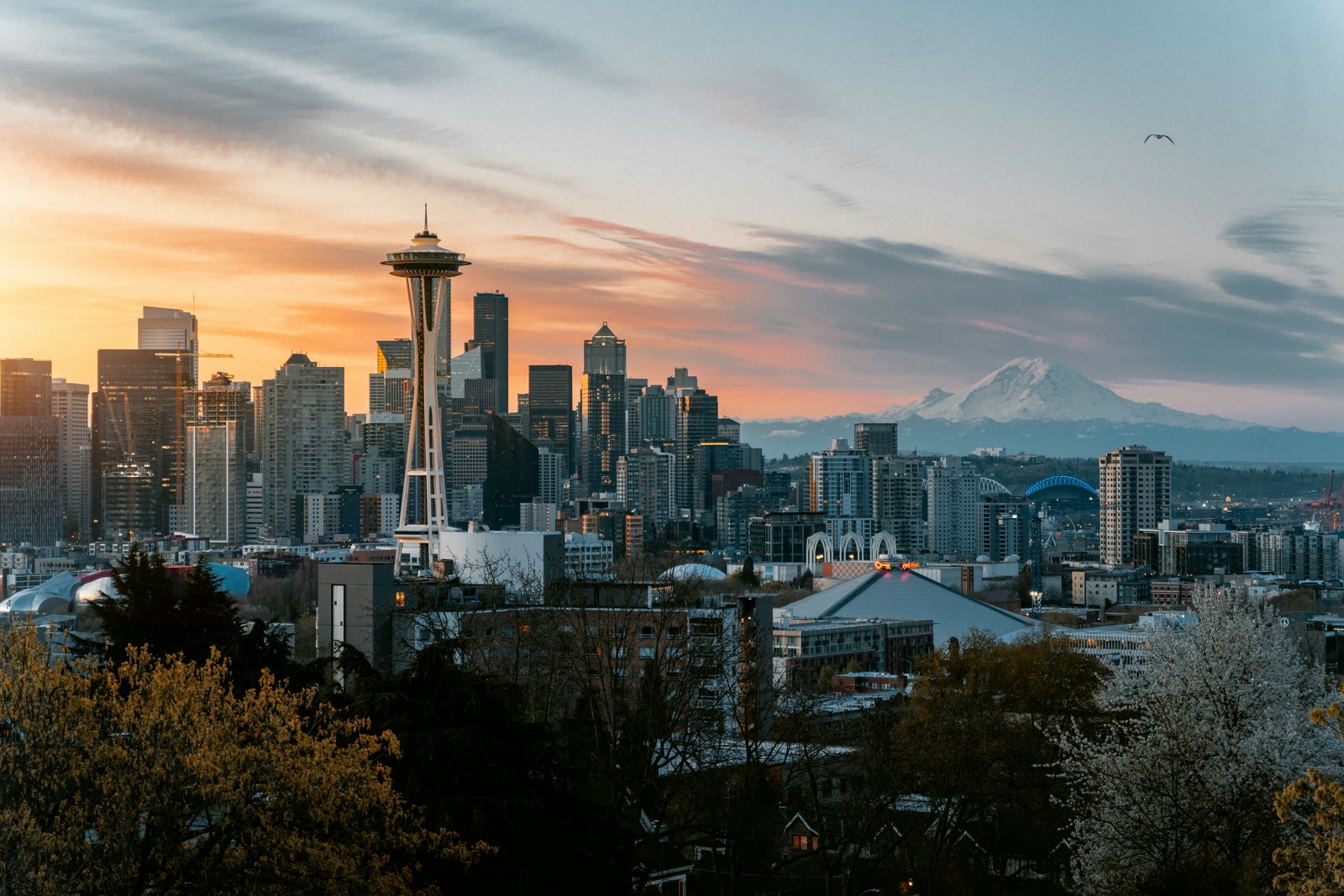
Seattle sits on the isthmus between Puget Sound and Lake Washington in the Pacific Northwest, at 47.6 degrees north latitude, the same as Paris and farther north than Montreal. This maritime position shapes everything about the city’s climate: mild winters that rarely freeze, dry summers that rarely overheat, and a reputation for rain that’s more about frequency than volume. Seattle gets 963mm (38 inches) of rain annually, less than New York or Miami, but spread across 150 days as persistent drizzle from November through March. Summers flip the script with July delivering only 18mm of rain and 310 hours of sunshine. The city is a hub for tech (Amazon, Microsoft), coffee culture (Starbucks was born here), and outdoor access with two mountain ranges an hour in either direction.
Seattle Weather at a Glance
Seattle has a temperate marine climate (Köppen Csb) with four distinct but mild seasons. Summer runs dry and pleasant: July and August both average 24 degrees C (76F) with 5-6 rain days per month and 280-310 hours of sunshine. Winter is cool but not cold: December through February sees highs of 8-10 degrees C (46-51F) and lows around 3 degrees C (37F). Snow is rare, averaging 13cm annually in the city center, while the Cascade passes get heavy snowfall for skiing. The rain shadow from the Olympic Mountains to the west means the city gets less precipitation than the Hoh Rainforest (3,600mm annually, a 3.5-hour drive west), but more than Sequim (400mm, 2 hours west).
Seasonal Snapshot
- Winter (December-February): Cool and damp with highs of 8-10 degrees C (46-51F), lows of 3 degrees C (37F). November is actually the wettest month (152mm). Skiing at Snoqualmie Pass and Stevens Pass peaks in January-February. Hotel rates are 30-40% lower than summer.
- Spring (March-May): A slow warm-up from 12 degrees C (54F) in March to 18 degrees C (65F) in May. Cherry blossoms at UW peak in late March. Rain drops from 100mm to 50mm across the season. May is when the city shakes off winter and restaurant patios fill.
- Summer (June-August): The payoff: 21-24 degrees C (70-76F) with 5-9 rain days per month. July is the driest month (18mm) with 310 hours of sunshine. The marine layer brings morning clouds that burn off by 11am. Hotels are at their most expensive and book out 2-3 months ahead.
- Autumn (September-November): September is often the best month: 21 degrees C (70F), 40mm of rain, and hotel rates drop 20-30% after Labor Day. October brings fall color. November returns full rain mode with 152mm and 19 rain days.
Quick Facts
- Best months for weather: July and August (24 degrees C/76F, 5-6 rain days)
- Warmest month: July and August both at 24 degrees C (76F) average high
- Coldest month: December at 8 degrees C (46F) high, 3 degrees C (37F) low
- Wettest month: November (152mm, 19 rain days)
- Driest month: July (18mm, 5 rain days)
- Annual rainfall: 963mm (38 inches) across ~150 days
- Annual sunshine: 2,170 hours
- Best value months: February and March (lowest hotel rates, active ski season nearby)
Location Context: What Shapes Seattle’s Weather
Seattle’s climate is defined by three geographic features. The Olympic Mountains to the west create a rain shadow: Seattle gets 963mm while the Hoh Rainforest on the Olympic Peninsula gets 3,600mm. Puget Sound moderates temperatures year-round, keeping winters warmer and summers cooler than inland cities at the same latitude. The Cascade Range to the east blocks continental air masses, preventing the extreme cold that hits Spokane (390km east), which routinely drops to -12 degrees C (10F) in winter. The convergence zone north of the city (Everett to Shoreline) gets 20-30% more rain than downtown Seattle due to airflow patterns off the Olympics.
Seattle Travel Guides
- Seattle Weather by Month – Monthly temperatures in Celsius and Fahrenheit, rainfall data, sunshine hours, and what to expect each season with an easy-to-read climate table.
- Best Time to Visit Seattle – When to go for the best weather, fewest crowds, lowest prices, and specific events. Exact date ranges and month-by-month trade-offs.
- Things to Do in Seattle – The Space Needle, Pike Place Market, museums, parks, and ferry rides. Hours, ticket prices in USD, and practical tips for 12 top attractions.
- Seattle Events and Festivals – Bumbershoot, Seafair, SIFF, Northwest Folklife, and seasonal events with dates, ticket prices, and what to expect at each one.
- Seattle Neighborhoods – Capitol Hill, Ballard, Fremont, Queen Anne, Pioneer Square, and more. Average hotel prices, transit access, and who each area suits best.
- Where to Stay in Seattle – Area-by-area hotel recommendations with specific hotels at luxury, mid-range, and budget tiers. Real Booking.com links for each property.
- Seattle Travel Tips and FAQ – Airport transport (SEA to downtown in 38 minutes for US$3.25), getting around, packing advice, tipping customs, safety, and day trip recommendations.
Suggested Hotels in Seattle
Four Seasons Hotel Seattle
Downtown luxury at 99 Union Street with a rooftop infinity pool overlooking Elliott Bay, a full-service spa, and Goldfinch Tavern by Ethan Stowell. Best for couples and luxury travelers who want walkable Pike Place Market access and the highest service level in the city. Check rates and availability
The Edgewater Hotel
Seattle’s only over-water hotel, built on Pier 67 with rooms directly above Elliott Bay, gas fireplaces, and rustic lodge-style interiors. The Beatles famously fished from their room window here in 1964. Best for romantic getaways and travelers who want a uniquely Seattle waterfront experience. Check rates and availability
Moore Hotel
Operating since 1907 at 2nd Avenue and Virginia Street in Belltown, the Moore Hotel offers simple, clean rooms from US$90-130 per night in low season. Location cannot be beat at this price, a 5-minute walk to Pike Place Market. Best for budget travelers who prioritize central access over luxury amenities. Check rates and availability
